
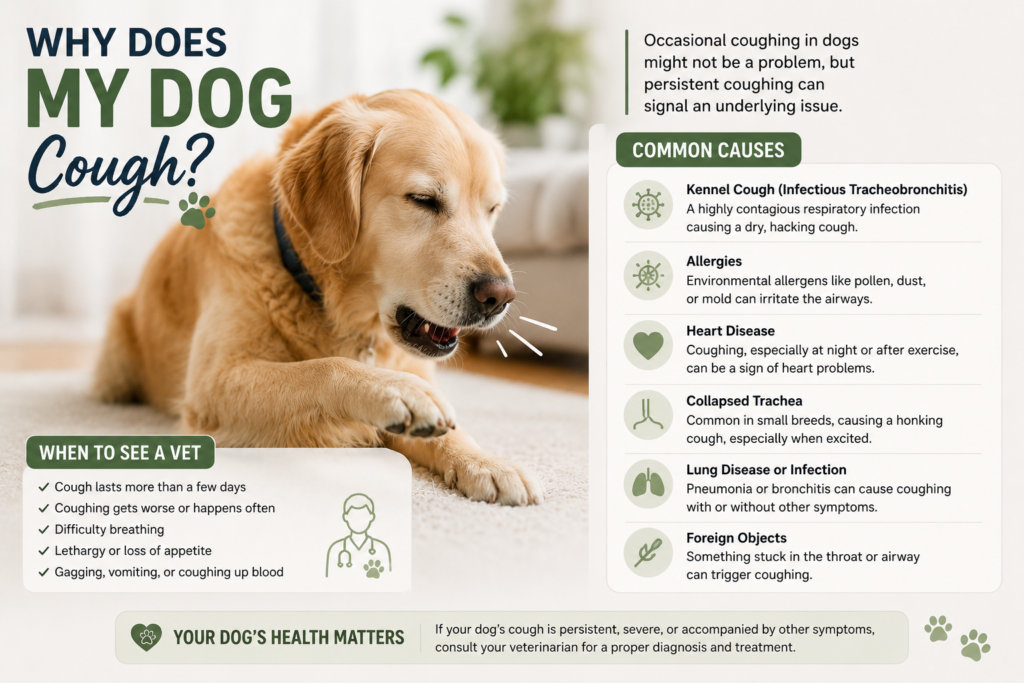
Why does my dog cough? An occasional cough may happen because your dog drank water too quickly, inhaled some dust, or experienced temporary throat irritation. But repeated or persistent coughing can sometimes signal an underlying health problem.
Dogs can cough for many different reasons, ranging from minor irritation and allergies to respiratory infections, heart problems, or something stuck in the airway. Paying attention to when your dog coughs, what the cough sounds like, and whether other symptoms are present can help determine when veterinary attention may be needed.
If your dog is sneezing as well, read our guide Why Does My Dog Sneeze? Common Reasons Explained.
1. Minor Throat Irritation
Just like people, dogs occasionally cough when something temporarily irritates their throat or airway.
This may happen after:
- Drinking water too quickly
- Eating too fast
- Inhaling dust
- Exposure to smoke or strong fragrances
- Pulling against a collar
- Barking excessively
A brief cough that disappears quickly and isn’t accompanied by other symptoms is usually less concerning.
However, coughing that keeps returning deserves closer attention.
2. Kennel Cough
Kennel cough is a common cause of coughing in dogs. The term describes a contagious respiratory illness that can involve several infectious organisms.
Dogs may be exposed anywhere they have close contact with other dogs, including boarding facilities, dog parks, daycare centers, training classes, grooming facilities, or shelters.
A dog with kennel cough may have:
- A dry, hacking cough
- A cough that may sound like honking
- Gagging or retching after coughing
- Sneezing
- Mild nasal discharge
Some dogs otherwise remain active and continue eating normally, while others may develop more noticeable symptoms.
Because other conditions can cause similar coughing, contact your veterinarian if you suspect kennel cough. It’s also a good idea to keep a coughing dog away from other dogs until you know whether the illness could be contagious.
3. Allergies and Airborne Irritants
Smoke, dust, pollen, household sprays, perfume, and other airborne substances can irritate a dog’s respiratory system.
You may notice that coughing occurs more frequently in a particular room, during certain seasons, or after using a household product.
Reducing exposure to possible irritants may help, but persistent coughing should still be evaluated by a veterinarian rather than assumed to be an allergy.
4. Heart Disease
Coughing can sometimes be associated with heart disease, particularly in older dogs.
Depending on the underlying condition, other signs may include:
- Reduced tolerance for exercise
- Rapid or difficult breathing
- Weakness
- Restlessness
- Fainting or collapse
- Tiring more easily than usual
A cough alone does not mean that your dog has heart disease. Many respiratory conditions can produce similar symptoms, which is why veterinary examination is important.
If your older dog develops a new or persistent cough, don’t simply assume that it is a normal part of aging.
5. Collapsing Trachea
Tracheal collapse occurs when the windpipe becomes weakened and partially flattens, making it harder for air to move normally.
It is more commonly seen in small and toy breeds, although other dogs can also be affected.
The cough associated with tracheal collapse is often described as a distinctive dry or goose-honk-like cough.
Episodes may become more noticeable during:
- Excitement
- Exercise
- Hot weather
- Eating or drinking
- Pressure on the neck
If your dog frequently coughs when pulling against a collar, ask your veterinarian whether a harness may be more appropriate. Persistent honking coughs should be professionally evaluated rather than diagnosed at home.
Some dogs with respiratory problems also make unusual sounds while sleeping. Learn more in Why Does My Dog Snore? Common Reasons Explained.
6. Respiratory Infections
Various respiratory infections can cause coughing.
Depending on the cause, coughing may occur together with:
- Sneezing
- Nasal discharge
- Fever
- Reduced appetite
- Low energy
- Difficulty breathing
Dogs with respiratory symptoms may also spread certain infections to other dogs.
Contact your veterinarian if your dog has a persistent cough or develops additional symptoms, especially after recent contact with other dogs.
7. Something Stuck in the Throat or Airway
Dogs explore the world with their mouths and noses, which means grass, plant material, pieces of food, or other small objects can occasionally become lodged in the throat or airway.
Possible signs include:
- Sudden coughing
- Gagging
- Pawing at the mouth
- Drooling
- Repeated swallowing
- Difficulty breathing
- Visible distress
A dog that suddenly cannot breathe normally requires immediate veterinary attention.
Do not reach deep into your dog’s throat unless an object is clearly visible and can be safely removed without pushing it farther into the airway.
8. Other Causes of Persistent Coughing
Not every cough fits neatly into one category. Lung disease, parasites, inflammation, airway abnormalities, masses, and other medical conditions can also cause coughing.
This is one reason the duration and pattern of the cough matter.
A veterinarian may need information such as:
- When the coughing started
- How often it occurs
- Whether it happens during exercise or rest
- Whether it happens at night
- Whether eating or drinking triggers it
- Whether your dog has recently been around other dogs
Recording a short video of the coughing episode can also be helpful because your dog may not cough during the veterinary appointment.
What Does Your Dog’s Cough Sound Like?
The sound of a cough can sometimes provide useful clues, although it cannot confirm a diagnosis on its own.
A dry, hacking cough may occur with airway irritation or infectious respiratory disease.
A honking cough may be associated with tracheal problems.
A wet or productive-sounding cough may suggest that fluid or mucus is present in the respiratory tract.
Coughing followed by gagging or retching can occur with several respiratory conditions and is sometimes mistaken for vomiting.
Rather than trying to diagnose your dog from the sound alone, pay attention to the entire pattern and any additional symptoms.
When Should You Call the Veterinarian?
Contact your veterinarian if your dog’s cough is persistent, worsening, or accompanied by other symptoms.
Veterinary attention is especially important if your dog:
- Coughs repeatedly
- Has been coughing for more than a few days
- Has difficulty breathing
- Breathes unusually fast while resting
- Coughs up blood
- Has nasal discharge or fever
- Refuses food or water
- Appears weak or unusually tired
- Collapses or faints
- Has a sudden severe coughing or choking episode
Difficulty breathing, blue or very pale gums, collapse, or suspected airway obstruction requires urgent veterinary care.
How Can You Help a Dog That Is Coughing?
What helps depends entirely on why your dog is coughing, so treating an unexplained persistent cough at home isn’t a good idea.
In the meantime, you can:
- Keep your dog away from cigarette smoke
- Avoid strong fragrances and aerosol sprays
- Keep activity gentle if exercise triggers coughing
- Provide fresh water
- Keep your dog away from other dogs if an infectious illness is possible
- Record coughing episodes to show your veterinarian
Never give your dog human cough medicine unless your veterinarian specifically recommends a particular medication and dose. Some human medications can be dangerous for dogs.
If your dog is breathing faster or panting more than usual without coughing, our guide Why Is My Dog Panting? Common Causes Explained may also be helpful.
Frequently Asked Questions
Why does my dog cough but otherwise seem fine?
A brief occasional cough can result from temporary throat irritation, drinking too quickly, or inhaling dust. However, dogs with some respiratory conditions may initially appear otherwise normal. Contact your veterinarian if the coughing becomes frequent or persistent.
Why does my dog cough after drinking water?
Dogs sometimes cough after drinking too quickly because a small amount of water irritates the airway. Frequent coughing after drinking, however, deserves veterinary evaluation.
Why does my dog cough at night?
Several conditions can cause coughing during rest or at night, including respiratory and heart-related problems. Repeated nighttime coughing should be discussed with your veterinarian.
Why does my dog cough when excited?
Excitement can trigger coughing in dogs with sensitive or narrowed airways, including some dogs with tracheal collapse. If it happens regularly, have your dog examined by a veterinarian.
Why does my dog’s cough sound like a goose honk?
A goose-honk-like cough is commonly associated with irritation or narrowing of the trachea and can occur with tracheal collapse. However, the sound alone cannot diagnose the cause, so recurring episodes should be evaluated by a veterinarian.
Is kennel cough serious?
Many otherwise healthy dogs have relatively mild illness, but complications can occur and other conditions can look similar. Puppies, older dogs, and dogs with underlying health problems may require closer veterinary attention.
Final Thoughts
An occasional cough isn’t always a reason for concern, but persistent or repeated coughing should not be ignored.
Minor throat irritation may be responsible, but infections, airway problems, heart disease, or other medical conditions can produce similar symptoms. Watching for changes in your dog’s breathing, energy, appetite, and behavior can provide important clues.
If you’re unsure why your dog is coughing or the cough continues, a veterinary examination is the safest way to determine what is happening.
Disclaimer: This article is for general informational purposes only and is not a substitute for professional veterinary advice. If your dog has persistent coughing, difficulty breathing, weakness, collapse, or other concerning symptoms, contact your veterinarian.