What to pack for a day hike with your dog might seem simple until you start thinking about everything that could happen on the trail.
Water, a leash, and a few treats sound like enough. But what if the trail takes longer than expected, the weather changes, or your dog suddenly needs a break?
The truth is, a good hike with your dog starts before you leave the house.
You don’t need expensive equipment or a backpack full of things you’ll never use. You just need to be prepared for your dog’s comfort, safety, and basic needs.
Whether you’re planning a peaceful forest walk or a longer adventure in the hills, here’s what to bring, what you can leave at home, and how to make sure your dog enjoys the experience as much as you do.
Plan the Hike Before You Pack the Bag
Not every hiking trail is suitable for every dog.
A shaded woodland path and a steep, rocky mountain trail can be completely different experiences, even if they’re the same distance.
Before choosing a route, consider:
- Distance and elevation: How far will you walk, and how much climbing is involved?
- Weather: Will temperatures rise during the day? Is rain or a thunderstorm possible?
- Shade and water: Are there shaded resting spots along the route?
- Trail surface: Will your dog encounter sharp rocks, hot gravel, mud, or slippery ground?
- Trail regulations: Are dogs allowed, and do they need to remain on a leash?
- Emergency access: How far will you be from your car or the nearest veterinary clinic?
Most importantly, think about your dog’s individual abilities.
A healthy adult dog accustomed to regular exercise may enjoy a longer hike, while a puppy, senior dog, or dog with mobility problems may need something shorter and easier.
If you’re unsure how much walking is appropriate, our guide on How Far Can a Dog Hike? explains how age, fitness, and health can affect hiking distance.
For puppies, avoid relying on the popular five-minutes-per-month rule. Exercise should be adapted to their development, vaccination status, and veterinary recommendations.
And remember: reaching the destination is only half the journey. Your dog still needs enough energy to walk back.
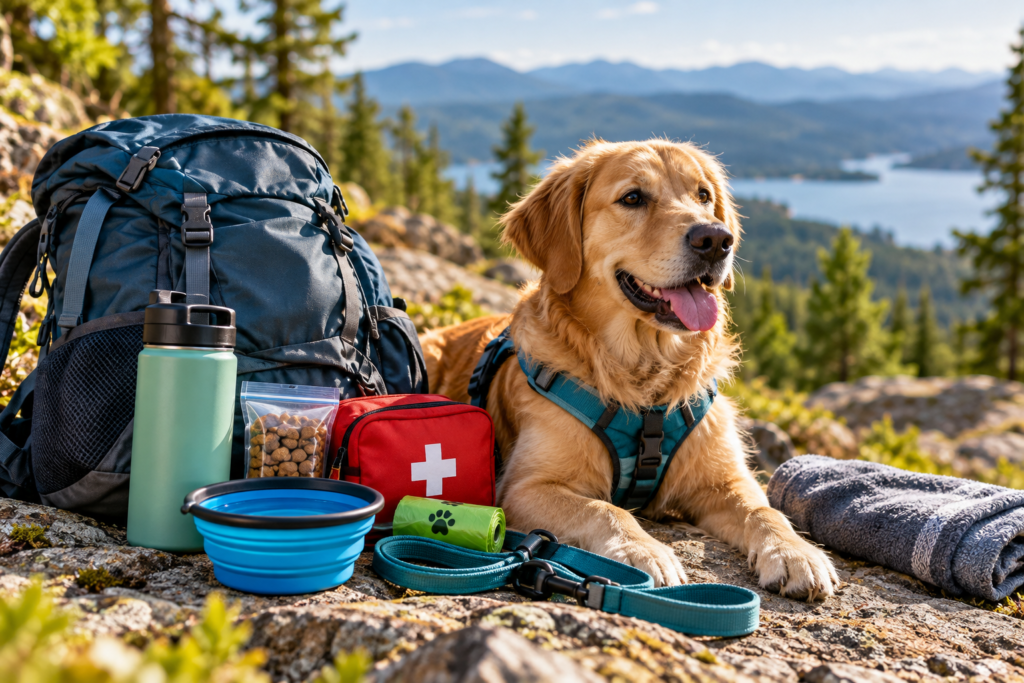
The Essential Dog Hiking Checklist
Before getting into the details, here’s a quick overview of what belongs in your backpack.
Essentials for Every Hike
- Fresh drinking water
- Portable dog bowl or water bottle
- Treats and appropriate food
- Comfortable harness
- Reliable leash
- Waste bags
- Basic dog first aid kit
- Identification tag
- Updated microchip information
- Tick prevention appropriate for your dog
- Charged phone and trail information
Extras Depending on the Trail
- Dog hiking boots
- Lightweight towel
- Weather-appropriate dog coat
- Reflective gear or safety light
- Spare leash
- Resting mat
- Additional food and water
- Emergency carrying equipment
You probably won’t need every optional item on every hike. The goal is to pack for the conditions you’re actually going to encounter.
1. Water and a Portable Dog Bowl
If there’s one thing you should never leave behind, it’s water.
Dogs need access to fresh drinking water during physical activity, especially when the weather is warm, the trail involves climbing, or you’re spending several hours outdoors.
A collapsible bowl or portable dog water bottle makes offering water much easier.
I wouldn’t rely on finding streams, ponds, or lakes along the way. Natural water sources can contain bacteria, parasites, harmful algal blooms, or other contaminants. Some trails also have no accessible water at all.
Bring clean water from home and offer it regularly.
Don’t wait until your dog seems desperate for a drink.
If you’re looking for convenient options, explore our Best Dog Water Bottles for Walks and Travel in 2026.
How Much Water Should You Bring for Your Dog?
There isn’t one exact amount that works for every dog.
Water requirements depend on:
- Body size
- Temperature and humidity
- Activity level
- Hiking distance
- Trail difficulty
- Individual health
The safest approach is to carry more than you expect to need and plan regular drinking breaks.
Offer smaller amounts frequently rather than encouraging your dog to drink an enormous quantity all at once.
If your dog starts slowing down, panting unusually heavily, or behaving differently, stop and assess the situation.
Water is essential, but it cannot make an overheated or exhausted dog safe to continue hiking.
2. Food and High-Value Treats
Even on a relatively short hike, treats are worth bringing.
They’re useful for rewarding your dog when they respond to a command, stay close, or calmly pass another dog on a narrow trail.
High-value treats can be especially helpful when you’re surrounded by exciting distractions.
For longer hikes, consider packing a portion of your dog’s regular food, depending on their usual feeding schedule and individual needs.
A few practical tips:
- Choose food that’s easy to carry.
- Store treats in a resealable container.
- Avoid foods that spoil quickly in warm weather.
- Don’t introduce unfamiliar treats during the hike.
- Keep food securely packed away from wildlife.
An upset stomach is the last thing you want when you’re miles from the car.
Also, avoid feeding a large meal immediately before or after strenuous exercise. This is particularly important for dogs at risk of gastric dilatation-volvulus (bloat).
If you’re unsure about meal timing, ask your veterinarian.
3. A Comfortable Hiking Harness and Reliable Leash
A comfortable harness can make a real difference on longer walks.
Something that seems perfectly fine during a ten-minute neighborhood walk might start rubbing or restricting movement after several hours.
Before heading out, check that your dog’s harness fits properly.
Look for:
- Adjustable straps
- Comfortable padding
- Secure buckles
- Strong leash attachment points
- A design that allows natural shoulder movement
- Reflective details for visibility
A handle may also be useful on certain trails, depending on your dog’s size and the harness design. However, don’t assume every handle is suitable for lifting a dog.
Check the fit again during your first rest stop, especially if you’re using new equipment.
A secure leash is just as important.
Even dogs with excellent recall can become distracted by wildlife, unfamiliar dogs, or sudden noises.
Always follow local leash regulations and respect other hikers.
For more equipment options, see our Best Dog Hiking Harnesses in 2026.
4. Waste Bags
Waste bags aren’t the most exciting hiking accessory, but they’re essential.
Bring more than you think you’ll need.
Pick up after your dog and dispose of waste according to local trail rules.
If there are no bins available, be prepared to carry the sealed bags out with you.
Leaving filled bags beside a trail, even if you plan to collect them later, isn’t a good solution. Bags are easily forgotten, and they can harm the environment.
A small holder attached to your leash or backpack makes waste bags easy to access.
It’s a simple way to keep shared outdoor spaces clean for everyone.
5. A Basic Dog First Aid Kit
You don’t need to carry an entire veterinary clinic in your backpack.
But a small first aid kit can be incredibly useful if your dog scrapes a paw, picks up a thorn, or suffers another minor injury.
Consider including:
- Sterile gauze pads
- Non-stick wound dressings
- Self-adhering bandage wrap
- Saline solution for rinsing debris
- Blunt-tip tweezers
- A tick-removal tool
- Disposable gloves
- A small clean towel
- Your veterinarian’s contact information
Keep everything in a waterproof pouch.
It’s also worth learning basic canine first aid before taking your dog on remote trails.
Remember that first aid is temporary care, not a replacement for veterinary treatment.
Never give your dog human painkillers or apply medications without veterinary guidance.
Before a longer hike, find out where the nearest emergency veterinary clinic is located.
You might not need that information, but you’ll be glad to have it if something unexpected happens.
6. Tick Protection and a Tick-Removal Tool
Woodland trails, grassy fields, and areas with dense vegetation can expose dogs to ticks.
Before your hike, make sure your dog is using an appropriate tick-prevention product recommended by your veterinarian.
Tick protection is important because ticks can transmit diseases, and some are difficult to spot until they’ve already attached.
Carry a suitable tick-removal tool and check your dog carefully after returning home.
Pay special attention to:
- Around the ears
- Under the collar
- Armpits
- Groin
- Between the toes
- Around the tail
- Under long or thick fur
If you have a long-haired dog, you probably already know how easily small things can disappear into their coat.
Take your time and use your hands to feel for anything unusual.
For more prevention tips, read our guide on How to Protect Dogs From Ticks.
7. Identification and Emergency Information
Even a well-trained dog can become frightened or distracted in an unfamiliar environment.
A sudden noise, wildlife encounter, or unexpected situation can cause a dog to run off.
Make sure your dog wears an identification tag with your current phone number.
Their microchip registration should also contain accurate contact information.
A microchip can help identify a lost dog, but it doesn’t work as a GPS tracker.
For longer hikes, save a few important details on your phone:
- Your veterinarian’s phone number
- A nearby emergency veterinary clinic
- The trailhead location
- An offline map of the route
- Emergency contact information
Mobile reception isn’t guaranteed in remote areas.
Letting someone know where you’re going and when you expect to return is another simple precaution.
8. Paw Protection for Rough or Hot Terrain
Not every dog needs hiking boots.
Many dogs are comfortable walking on suitable natural trails without them.
However, certain conditions can put extra stress on paw pads.
Sharp rocks, rough gravel, hot surfaces, ice, and road salt can all cause problems.
Before your hike, inspect your dog’s paws for cuts, cracks, or irritation.
During longer walks, check them again at rest stops.
If you’re considering dog boots, introduce them gradually at home.
Don’t expect your dog to wear unfamiliar boots comfortably for several hours on their first attempt.
Fit matters because poorly fitting boots can rub or interfere with normal movement.
Be Careful With Hot Ground
Asphalt, rocks, and other exposed surfaces can become much hotter than the surrounding air.
Touching the surface can help alert you to dangerous heat, but it isn’t a reliable guarantee that the ground is safe for your dog’s paws.
When conditions are hot, choose shaded routes, avoid exposed surfaces, and consider postponing the hike
For more summer safety advice, read When Is It Too Hot to Walk Your Dog?.
9. A Lightweight Towel
A towel might not seem essential until your dog decides to investigate a muddy puddle.
A small microfiber towel is easy to pack and can be useful for:
- Drying wet fur
- Cleaning muddy paws
- Removing loose dirt
- Protecting car seats after the hike
- Providing a clean resting surface
Choose something lightweight that dries quickly.
It’s a particularly useful addition for dogs with longer coats that collect mud, leaves, and other trail debris.
10. Extra Gear for Longer Hikes
For a short walk on a familiar trail, basic supplies may be enough.
Longer adventures can require a little more preparation.
Depending on the route and weather, you might consider bringing:
- A spare leash
- Reflective gear
- A waterproof dog coat
- A lightweight resting mat
- Extra food and water
- An emergency carrying aid
- A dog backpack, if appropriate
If your dog will carry a backpack, introduce it gradually and make sure the fit and weight are suitable.
Young dogs, seniors, and dogs with health problems may not be appropriate candidates for carrying additional weight.
The goal isn’t to carry as much equipment as possible.
It’s to bring what makes your particular hike safer and more comfortable.
How to Adjust Your Packing for Different Hikes
You don’t need exactly the same supplies for every outdoor adventure.
Here’s how I would adjust the checklist.
Short Shaded Hike (1–2 Hours)
Bring the essentials: water, a bowl, treats, harness, leash, waste bags, identification, and basic first aid supplies.
Even on a short hike, check the weather and trail conditions.
Half-Day Hike
Pack extra water, additional treats, and supplies for longer rest stops.
Check your dog’s paws during breaks and perform a thorough tick check afterward.
Full-Day Hike
Bring additional food and water, a towel, a spare leash, and any equipment required for the terrain.
Plan regular breaks and make sure your dog can comfortably complete the return journey.
Hot-Weather Hike
Choose a cooler time of day, shorten the route, and prioritize shade and water.
Avoid strenuous activity during hot or humid conditions.
Cooling accessories may provide some comfort, but they don’t make dangerous temperatures safe.
If the weather is too hot, skip the hike.
Cold or Wet-Weather Hike
Depending on your dog’s coat, age, size, and health, you may need a suitable coat, paw protection, and a dry towel.
Watch for shivering, weakness, or signs of discomfort.
Not every dog tolerates cold conditions equally well.
Know When It’s Time to Turn Around
This might be the most important hiking advice of all.
Watch your dog, not the map.
Dogs don’t understand that you’ve planned to reach a particular viewpoint or finish a certain number of miles.
They depend on you to notice when something isn’t right.
Warning signs include:
- Unusually heavy panting
- Repeatedly stopping or falling behind
- Limping
- Weakness or stumbling
- Refusing to continue
- Unusual behavior
- Signs of pain or distress
If your dog seems tired, stop and allow them to rest.
But don’t assume every problem is ordinary fatigue.
Severe panting, weakness, collapse, confusion, or difficulty breathing can indicate a medical emergency.
What If Your Dog Becomes Overheated?
If you suspect heatstroke, act immediately.
Move your dog away from the heat and begin cooling them promptly with cool water while keeping water away from their nose and mouth.
Contact an emergency veterinarian immediately and arrange urgent treatment.
Don’t wait to see whether your dog improves before seeking help.
Heatstroke can cause serious internal damage even when a dog initially appears to recover.
And remember, turning around early isn’t a failed hike.
It’s a responsible decision that puts your dog’s well-being first.
Common Hiking Mistakes Dog Owners Should Avoid
A little preparation can prevent many uncomfortable situations.
Packing Too Little Water
Don’t assume a stream will be available or safe.
Carry clean water for your dog and yourself, plus extra for unexpected delays.
Choosing a Trail That’s Too Difficult
A route that feels manageable to you may be exhausting for your dog.
Start with easier trails and gradually increase the challenge when appropriate.
Using Brand-New Equipment
Test harnesses, boots, and backpacks on shorter walks before a longer adventure.
Ignoring the Weather
A cool morning can turn into a hot afternoon.
Check the forecast for the entire time you’ll be outdoors, not just your starting time.
Forgetting the Return Journey
Your dog needs enough energy to make it back safely.
Plan the full distance and allow time for breaks.
My Simple Pre-Hike Checklist
Before leaving home, here’s a final checklist worth saving on your phone.
- Water for both of us, plus extra
- Portable dog bowl
- Treats and appropriate food
- Comfortable harness and secure leash
- Waste bags
- Basic dog first aid kit
- Tick prevention and removal tool
- Identification tag and updated microchip information
- Paw protection if needed
- Weather-appropriate extras
- Charged phone and offline map
- Trail rules checked
- Emergency contact and return plan shared
Once everything is packed, you’re ready to enjoy the trail without constantly wondering what you might have forgotten.
Frequently Asked Questions
What Should I Pack for a Short Hike With My Dog?
For a short hike, bring fresh water, a portable bowl, treats, a comfortable harness, a secure leash, waste bags, identification, and basic first aid supplies.
Adjust your packing according to the weather and terrain.
Does My Dog Need Hiking Boots?
Not necessarily.
Many dogs can hike comfortably without boots on suitable trails. However, boots may be useful for sharp, rocky, icy, or otherwise challenging surfaces.
They should fit properly, and your dog should be comfortable wearing them before a long hike.
How Much Water Should I Bring for My Dog?
The amount depends on your dog’s size, activity level, the weather, and the trail.
Bring more than you expect to need and offer water regularly during breaks.
Can I Take My Puppy on a Day Hike?
Puppies can enjoy suitable outdoor exploration, but demanding or lengthy hikes may not be appropriate while they’re developing.
Consider your puppy’s age, growth, vaccination status, and veterinary recommendations.
Should I Feed My Dog During a Hike?
Small treats can be useful for training and rewards.
For longer outings, you may need to bring some of your dog’s usual food, depending on their feeding schedule and individual needs.
Avoid large meals close to strenuous exercise.
Can I Leave My Dog Off-Leash on a Hiking Trail?
Only where local regulations permit it and where doing so is safe.
Even a well-trained dog can be distracted by wildlife or unfamiliar situations.
Keeping your dog on a leash can help protect wildlife, other hikers, and your dog.
What Should I Do If My Dog Refuses to Continue Hiking?
Stop and assess the situation.
Your dog may be tired, injured, overheated, or experiencing another problem.
Don’t force them to continue.
If your dog shows signs of illness, severe distress, weakness, or collapse, seek veterinary assistance immediately.
Final Thoughts
A good day hike with your dog doesn’t depend on how far you travel or how much expensive gear you own.
It’s about being prepared, choosing a suitable route, and paying attention to your dog’s needs.
Water, a comfortable harness, food or treats, waste bags, and basic safety supplies will cover many everyday hiking situations. The rest depends on the trail, the weather, and your individual dog.
Start with manageable adventures, take breaks when needed, and never feel pressured to finish a route if your dog isn’t comfortable.
Sometimes the best part of a hike isn’t reaching the destination. It’s simply spending time outdoors together, exploring new places, and enjoying the little moments along the way.
What’s one thing you never leave behind when hiking with your dog? Share your favorite hiking essential in the comments.
Disclaimer: This article is for informational purposes only and does not replace professional veterinary advice. Always consider your dog’s age, health, fitness level, and individual needs before planning a hike. Consult your veterinarian if you’re unsure whether a particular activity is suitable for your dog. If your dog shows signs of serious illness, injury, or heatstroke, seek urgent veterinary care.