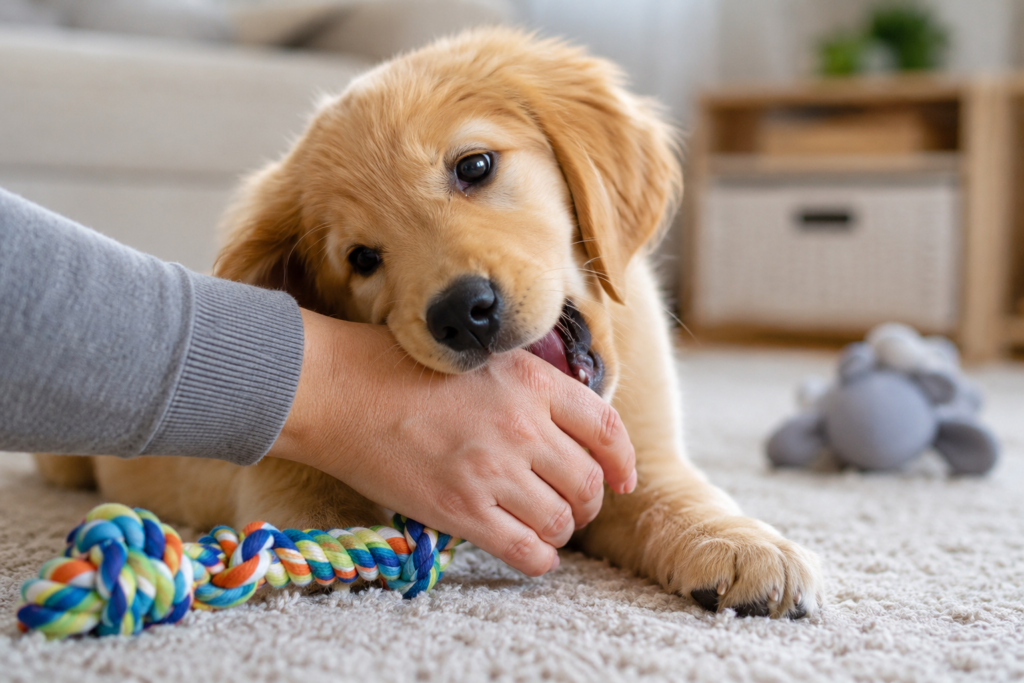
Puppy teeth may be tiny, but they can hurt.
If your puppy seems determined to bite your hands, ankles, clothes, furniture, and almost everything else they can reach, you’re not alone. Mouthing and play biting are normal parts of puppy development, and teething can make chewing even more tempting.
The goal isn’t to expect a young puppy to stop using their mouth overnight. Instead, you want to teach them what they can bite, how hard is too hard, and what behaviors get rewarded.
Here are practical ways to start.
Why Do Puppies Bite So Much?
Puppies explore the world with their mouths.
They may bite or mouth because they’re:
- Playing
- Teething
- Excited
- Overtired
- Seeking attention
- Exploring something new
- Trying to start interaction with you
Young puppies also learn important bite inhibition skills through appropriate interaction and socialization.
So puppy biting doesn’t automatically mean you have an aggressive dog.
However, there is an important difference between normal puppy mouthing and behavior involving fear, guarding, stiff body language, growling, snarling, or more serious biting. If you’re concerned that you’re seeing aggression rather than ordinary puppy behavior, seek professional advice
1. Redirect Biting to an Appropriate Toy
One of the easiest things you can do is give your puppy something they’re allowed to bite.
Keep suitable puppy toys nearby.
When your puppy starts grabbing your hands or clothing, calmly redirect them to a toy.
The idea is simple:
Hands aren’t chew toys. Toys are.
When your puppy chooses the toy instead, continue playing or give them calm praise. Reward-based training helps puppies learn which behaviors lead to good things.
2. Stop the Fun When Biting Gets Too Rough
Sometimes your attention is exactly what your puppy wants.
If biting makes you wave your hands, shout, chase them, or wrestle with them, your puppy may think they’ve discovered an amazing game.
Instead, when biting becomes too rough, calmly stop interacting for a moment.
Remove your hands, stand up if necessary, and briefly end the game.
The lesson becomes:
Gentle play = play continues.
Hard biting = fun stops.
Removing attention can help teach puppies that mouthing doesn’t produce the interaction they’re looking for.
3. Avoid Playing With Your Hands
It’s confusing if your puppy is encouraged to wrestle with your hands one minute and corrected for biting them five minutes later.
Use toys for energetic games.
Tug toys, balls, soft puppy toys, and appropriate interactive toys create some distance between your puppy’s teeth and your fingers.
Consistency matters. Everyone in the household should follow roughly the same rules so your puppy isn’t receiving completely different messages from different people.
4. Give Your Puppy Appropriate Chew Toys
Teething can make puppies especially interested in chewing.
Puppies lose their baby teeth as adult teeth develop, and chewing appropriate items can help satisfy that natural urge.
Offer several puppy-safe options with different textures so you can discover what your puppy prefers.
Rotate toys instead of leaving every toy available all the time. An older toy can suddenly seem exciting again after being put away for a few days.
Avoid giving extremely hard items that could potentially damage developing teeth, and choose toys appropriate for your puppy’s size and chewing strength.
5. Watch for the Overtired Puppy
Sometimes the tiny land shark appears because your puppy simply needs rest.
Young puppies can become increasingly wild when they’re overtired. You may notice more zooming, grabbing clothes, jumping, and biting when they’ve had too much stimulation.
If biting suddenly becomes much worse after a long play session, training session, or busy day, give your puppy an opportunity to settle somewhere quiet.
A comfortable crate or puppy-safe area can help, provided your puppy has been positively introduced to that space.
Don’t use the crate as punishment for biting.
6. Use Food and Enrichment to Keep Their Brain Busy
Not every puppy needs more physical activity.
Sometimes they need something interesting to do.
Try age-appropriate activities such as:
- Food puzzles
- Treat-hiding games
- Sniffing activities
- Short training sessions
- Puppy-safe enrichment toys
Mental stimulation can give your puppy another outlet for their energy.
We recently covered several ideas in 9 Best Dog Enrichment Toys for Mental Stimulation in 2026.
7. Reward the Behavior You Want
It’s easy to spend all day reacting to the things your puppy does wrong.
Don’t forget to notice the good moments.
If your puppy approaches without biting, settles calmly, plays appropriately with a toy, or responds well during training, reward that behavior with praise, play, or a small treat.
Reward-based training helps dogs learn what behavior you actually want from them rather than relying on punishment for unwanted behavior.
8. Don’t Punish Puppy Biting
Avoid hitting, shouting at, pinning down, or physically intimidating your puppy.
Punishment can create fear and may make behavioral problems worse rather than teaching the puppy what to do instead. Reward-based approaches are recommended for training dogs.
Your puppy needs a clear alternative:
Don’t bite my hand → bite this toy instead.
That’s much easier to understand than simply being punished for doing something that comes naturally to puppies.
9. What About Biting Feet and Ankles?
Ankles are especially tempting because they move.
If your puppy attacks your feet every time you walk across the room, avoid turning it into a chase game.
Stop moving, redirect your puppy toward an appropriate toy, and reward them when they engage with that instead.
Keeping a toy nearby during the puppy stage can save both your patience and your socks.
How Long Does Puppy Biting Last?
There isn’t one exact age when every puppy suddenly stops biting.
Teething, individual temperament, training, environment, and development all influence how long the behavior lasts.
You should generally see improvement as your puppy matures and consistently learns appropriate ways to interact.
The important thing is to look for progress, rather than expecting perfect behavior immediately.
When Should You Be Concerned About Puppy Biting?
Normal puppy mouthing can look dramatic, but some behavior deserves professional attention.
Talk with your veterinarian or a qualified behavior professional if biting:
- Seems connected to fear
- Happens when someone approaches food or valued objects
- Is accompanied by stiff or threatening body language
- Frequently causes significant injury
- Is becoming more intense rather than improving
- Appears suddenly alongside other behavioral changes
Dogs often show warning signals before biting, including attempts to move away, lip licking, growling, snarling, or showing their teeth. Punishing warning signals such as growling can be counterproductive because it doesn’t address why the dog feels threatened.
FAQ
Is it normal for a puppy to bite constantly?
Frequent mouthing and play biting can be normal in young puppies, particularly during play and teething. The important part is consistently teaching appropriate alternatives and watching for signs that the behavior is driven by fear or aggression.
Should I yell “ouch” when my puppy bites?
Some puppies may stop when they hear a brief sound, while others become even more excited by it. If making a sound causes your puppy to become more wound up, calmly ending the interaction and redirecting them may work better.
Should I hold my puppy’s mouth closed?
No. Physical punishment or intimidation isn’t necessary for teaching appropriate mouth behavior and can create fear or conflict. Focus on redirection, appropriate chew toys, rewarding desired behavior, and briefly ending play when biting becomes too rough.
Why does my puppy bite me more in the evening?
Overtiredness, excitement, accumulated stimulation, and a need for appropriate chewing or enrichment can all contribute. Try shorter play sessions followed by a predictable calm routine.
What toys are best for a biting puppy?
Choose appropriately sized toys designed for puppies and their developing teeth. Soft rubber chew toys, appropriate tug toys, food puzzles, and other puppy-safe enrichment toys can provide alternatives to your hands and furniture.
Final Thoughts
Puppy biting can be frustrating, but it’s also a normal developmental behavior for many puppies.
Rather than trying to punish biting out of your puppy, focus on teaching them what works instead: appropriate toys, gentle play, calm interactions, and rewarding good choices.
Be consistent and give it time.
Those tiny puppy teeth won’t be around forever—and the habits you’re teaching now can help shape how your dog interacts with people as they grow.
This article is for informational purposes only and is not a substitute for professional veterinary or behavioral advice. If you’re concerned about your puppy’s behavior or biting, consult your veterinarian or a qualified dog behavior professional.