
Have you ever wondered what the world looks like through your dog’s eyes?
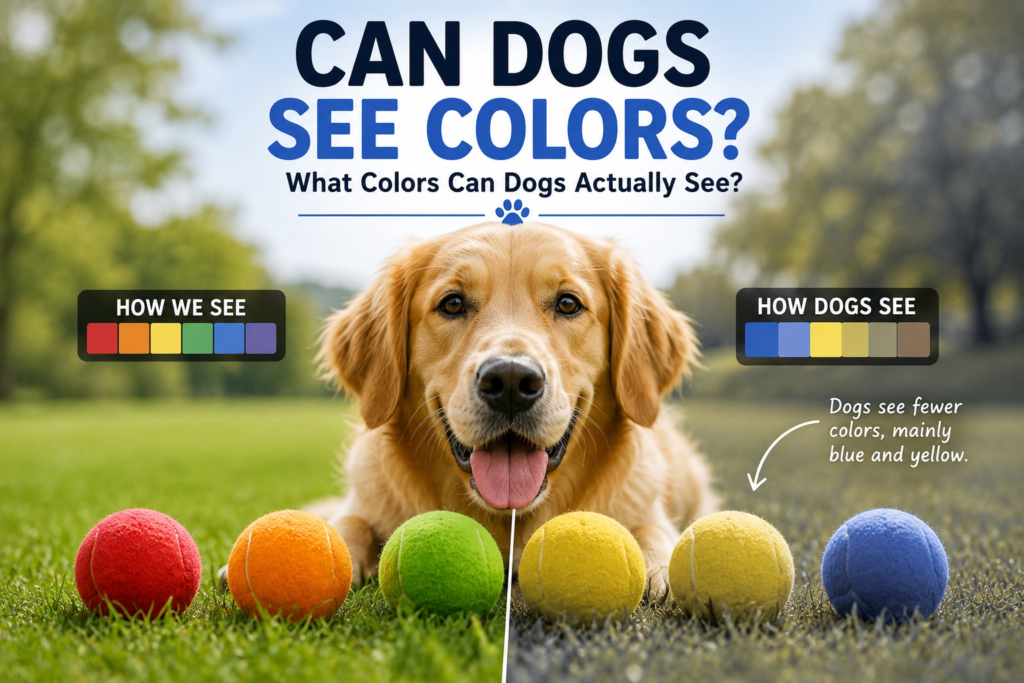
A common belief is that dogs see everything in black and white. But that isn’t true. Dogs can see colors — they simply see a smaller range of colors than humans do.
Their world isn’t colorless. Instead, it likely contains plenty of blues, yellows, grays and muted shades that look quite different from what we see.
So, what colors can dogs actually see?
Can Dogs See Colors?
Yes, dogs can see colors.
The difference comes from the structure of the eye. Humans typically have three types of color-detecting cone cells, while dogs have two.
This is known as dichromatic vision.
Because of this, dogs don’t distinguish the full range of colors that most humans can.
Their vision is often compared loosely to red-green color vision deficiency in humans.
What Colors Can Dogs See Best?
Dogs are particularly good at distinguishing colors in the blue and yellow ranges.
For example, they can generally differentiate:
- Blue
- Dark blue
- Light blue
- Yellow
- Some shades between yellow and brown
- Gray tones
Colors such as red, orange and green are more difficult for dogs to distinguish from surrounding colors.
That means the bright red toy that looks obvious to you may not stand out nearly as much to your dog.
What Does Red Look Like to a Dog?
Dogs don’t perceive red the same way humans do.
Rather than appearing as the bright, vivid red that we see, red may appear much duller — potentially as a brownish or dark yellow-gray shade.
This creates an interesting situation with dog toys.
Imagine throwing a bright red ball onto green grass.
To you, the ball immediately stands out.
To your dog, the colors of the ball and grass may be much less distinct from each other.
Your dog can still find the ball, of course, but movement, smell and other visual cues may be more useful than its color.
What Does Green Look Like to a Dog?
Green is another color dogs don’t perceive the way most humans do.
Many green shades may appear closer to yellowish or grayish tones.
So a green toy sitting on grass may provide relatively little color contrast.
This doesn’t mean your dog can’t see the object. Dogs use much more than color when locating things.
Shape, movement, brightness and scent can all help.
What About Purple and Orange?
Purple contains red and blue components.
Since dogs don’t process red normally, purple may look much more like blue to them.
Orange, meanwhile, may appear closer to a yellowish or brownish shade.
That’s why several colors that look dramatically different to us may look much more similar from a dog’s perspective.
Are Dogs Color-Blind?
Calling dogs “color-blind” can be misleading if it makes people think dogs can’t see color at all.
They can.
Dogs simply have dichromatic color vision, while humans generally have trichromatic color vision.
A better way to think about it is that dogs see a more limited color palette.
Their world still has color — just not the same palette as ours.
Do Dogs See Only in Black and White?
No.
This is one of the most persistent myths about dog vision.
Dogs can distinguish certain colors, particularly blues and yellows.
The black-and-white idea probably became popular because early research couldn’t accurately show exactly how animals perceived color.
Today, we know canine vision is more complex.
What Color Toys Are Best for Dogs?
If you want a toy that’s easy for your dog to visually distinguish, blue or yellow can be particularly useful choices.
For example, a blue toy may stand out more clearly against green grass than a red or green one.
That doesn’t mean you need to throw away every red toy your dog owns.
Dogs locate toys using multiple senses, especially smell, and many dogs happily play with toys regardless of color.
But if you’re choosing between identical toys in different colors, blue or yellow may provide better visual contrast.
Can Dogs See Colors on TV?
Yes. Dogs can perceive the colors they’re capable of seeing on television too.
However, color isn’t the only thing that attracts a dog’s attention to a screen.
Movement and sound can be much more interesting.
A running dog, bouncing ball or barking sound may immediately catch their attention regardless of the colors involved.
We already covered this in detail in our guide Can Dogs Watch TV?, where we explain what dogs actually see when looking at modern television screens.
Do Dogs See Better Than Humans?
Not exactly better or worse — their vision is adapted differently.
Humans generally have better color discrimination and visual detail.
Dogs, however, evolved with visual abilities suited to their own needs.
They also rely heavily on senses such as smell and hearing.
So judging a dog’s perception only by how many colors they can see misses a huge part of how dogs experience their environment.
Can Dogs See Better in the Dark?
Dogs are generally better equipped than humans to see in low-light conditions.
Their eyes contain adaptations that help make better use of limited available light.
One important feature is the tapetum lucidum, a reflective layer behind the retina.
It reflects light back through the retina, giving photoreceptor cells another opportunity to respond to it.
It’s also responsible for that familiar glowing-eye effect you may see when light hits your dog’s eyes at night.
Still, dogs can’t see in complete darkness. Some light needs to be present.
Does a Dog’s Vision Change With Age?
It can.
As dogs get older, age-related changes can affect their vision.
You might notice an older dog becoming more hesitant in dark environments, having difficulty navigating unfamiliar spaces or occasionally bumping into objects.
Sudden changes in vision at any age should be taken seriously.
If you notice your dog suddenly struggling to see, becoming unusually hesitant, developing changes in the appearance of their eyes, or showing signs of discomfort, contact your veterinarian.
Why Is Color Vision Useful to Dogs?
Color is only one piece of visual information.
Dogs also pay attention to:
- Movement
- Shape
- Contrast
- Brightness
- Distance
- Body language
Combine that with their exceptional sense of smell and strong hearing, and you get an animal experiencing the environment very differently from us.
That’s why asking “what does my dog see?” is much more complicated than simply looking at a color chart.
FAQ
Can dogs see red?
Dogs can see an object that is red, but they don’t perceive the color as the vivid red humans normally see.
Can dogs see green?
Dogs have difficulty distinguishing green in the same way humans do. Many green shades may appear more yellowish or grayish.
What colors can dogs see best?
Blue and yellow are among the colors dogs distinguish most effectively.
Is blue a good color for dog toys?
Yes. Blue can provide strong visual contrast in many environments, including against green grass.
Do dogs see everything in black and white?
No. Dogs can see color, although their color range is more limited than ours.
Can dogs see pink?
Pink contains red, so dogs don’t perceive it as we do. Depending on its shade and brightness, it may appear as a muted grayish, brownish or yellowish tone.
Final Thoughts
Dogs definitely don’t live in a black-and-white world.
They can see blue and yellow particularly well, while colors such as red and green are much harder for them to distinguish.
And while their color vision is more limited than ours, that’s only one small part of the way dogs experience their surroundings.
They combine vision with extraordinary smell, hearing, movement detection and other cues.
So next time your dog somehow loses that bright red ball in the middle of a green lawn, they may have a pretty good excuse.
Disclaimer: This article is for informational purposes only and is not a substitute for professional veterinary advice. Contact your veterinarian if you notice sudden or significant changes in your dog’s vision.