
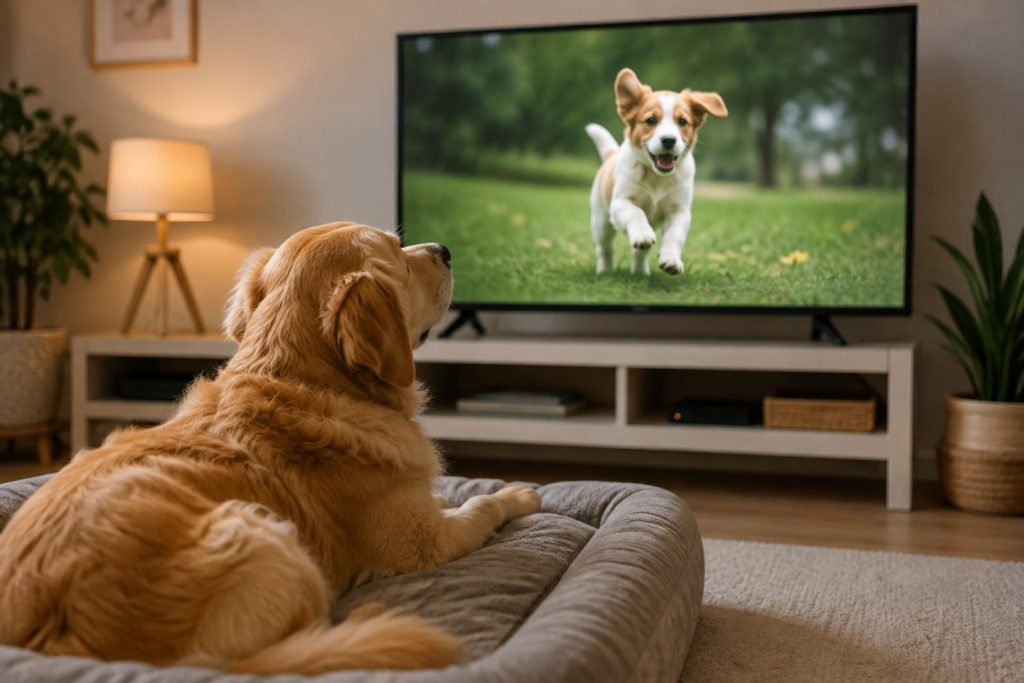
If your dog has ever stopped in the middle of the room to stare at a dog on TV, barked at an animal in a commercial, or completely ignored the screen while you were watching a movie, you may have wondered: can dogs actually watch TV?
The answer is yes — many dogs can see and react to television. But they don’t experience what’s happening on the screen exactly the way we do.
Some dogs seem fascinated by moving animals and sounds, while others barely notice the TV at all. Their reaction can depend on their eyesight, personality, breed, age, and even the type of television you have.
Here’s what your dog may actually be seeing when they settle down in front of the screen with you.
Can Dogs Actually See TV?
Yes. Dogs can see images and movement on modern television screens.
Older televisions refreshed images more slowly, which could make the picture appear less smooth to a dog. Modern TVs have much higher refresh rates, so the movement on screen is generally more convincing and easier for dogs to follow.
However, seeing the television doesn’t necessarily mean your dog understands that they’re watching a representation of something rather than the real thing.
A dog appearing on screen might trigger curiosity, excitement, barking, or even a quick investigation behind the television.
Other dogs quickly learn that nothing interesting actually comes out of the screen and stop paying much attention.
What Does TV Look Like to a Dog?
Dogs don’t see the world in exactly the same colors humans do.
Human vision is typically trichromatic, meaning our eyes use three types of color-sensitive cone cells. Dogs have dichromatic vision and primarily distinguish shades within the blue and yellow ranges.
They have more difficulty distinguishing reds and greens.
So your colorful movie doesn’t look quite the same to your dog.
Movement may actually be more important than color when it comes to catching a dog’s attention.
Want to know what the world actually looks like through your dog’s eyes? Learn more about what colors dogs can see, including how they perceive red, green, blue and yellow.
Why Do Some Dogs Love Watching TV?
For some dogs, television contains several things that naturally grab their attention.
They may notice:
- Other dogs
- Cats and other animals
- Fast movement
- Barking
- Squeaking toys
- Doorbells
- People running
- Wildlife
- Familiar voices and sounds
A dog suddenly running across the screen can be much more interesting than two people sitting at a table talking.
Sound can be equally important.
A dog may be relaxing without looking at the television and immediately lift their head when they hear barking.
Do Dogs Know the Animals on TV Aren’t Real?
This is where things get interesting.
Dogs can recognize visual information on screens, but their reaction doesn’t necessarily tell us exactly what they believe they’re seeing.
Some dogs bark at a television dog just as they would at a real dog outside the window.
Others stare for a few seconds and lose interest.
And some may walk toward or behind the television as though they’re trying to figure out where the animal went.
Dogs rely heavily on more than vision when understanding their environment — especially smell.
The dog on television looks and sounds like a dog but doesn’t smell like one.
That missing information may help explain why many dogs eventually treat television differently from real animals.
Can Dogs Recognize People on TV?
Dogs may respond to familiar people and voices on screens, although recognizing a person from a two-dimensional image isn’t exactly the same as recognizing someone standing in the room.
Their ability to identify people involves several cues, including appearance, movement, voice, and smell.
Why Does My Dog Bark at the TV?
Usually because something on the television has triggered a response.
Your dog may hear a bark, see another dog, notice fast movement, or react to something that resembles a real-life trigger.
For example, a dog that normally barks when someone rings your doorbell may also react when a doorbell rings in a TV show.
If your dog occasionally barks and quickly settles down, it usually isn’t a major concern.
But if watching television regularly causes intense barking, pacing, lunging at the screen, or prolonged agitation, it’s probably not entertaining for your dog.
In that situation, turning the television off or choosing calmer content is the better option.
Why Does My Dog Ignore the TV?
That’s completely normal too.
Not every dog finds screens interesting.
One dog might happily watch animals for several minutes while another walks straight past the television and goes to sleep.
Individual temperament matters, and dogs also differ in what captures their attention.
Age can play a role as well. Changes in vision or hearing may make television less interesting to some older dogs.
Do Dogs Prefer Certain TV Shows?
Dogs aren’t choosing between a crime drama and a romantic comedy based on the plot.
But the content can make a difference.
Videos featuring animals, outdoor environments and movement are more likely to attract some dogs than programs dominated by conversation.
Sounds such as barking, squeaking and other animal noises can also grab their attention.
That doesn’t mean every dog needs special “dog TV.”
If your dog doesn’t care about television, there’s no reason to encourage them to watch it.
Is TV Good Entertainment When Your Dog Is Home Alone?
Leaving the television on can provide background sound for some dogs, but it shouldn’t be considered a replacement for exercise, interaction and appropriate enrichment.
If your dog seems comfortable with background television, you can certainly leave something calm playing.
But a television doesn’t provide the same mental stimulation as sniffing, exploring, playing or interacting with people.
Dogs that spend time alone still need appropriate physical activity and mental enrichment.
If your dog spends a lot of time home alone, television may provide some background stimulation, but it shouldn’t be their only source of entertainment. Dogs also need physical activity, play, sniffing opportunities, and mental challenges throughout the day. If you’re wondering whether your dog is getting enough stimulation, check out our guide to [Signs Your Dog Is Bored] for common behaviors to watch for and simple ways to keep them engaged.
Can Dogs Watch TV for Too Long?
Dogs generally don’t sit inches from the screen scrolling through an entire season the way humans might, so “screen time” isn’t usually the same concern it is with people.
The more important question is how your dog reacts.
If your dog occasionally watches calmly, there’s little reason to worry.
If television causes persistent barking, stress or obsessive behavior, limit access to whatever content triggers that reaction.
And if your dog spends most of the day lying around watching the room — television or no television — make sure they’re also getting appropriate exercise, play and mental stimulation.
If your dog regularly spends time alone, you may also want to read our guide on How Long Can Dogs Stay Home Alone? for tips on keeping them comfortable and entertained while you’re away.
Do Dogs Dream About Things They See on TV?
We can’t know exactly what appears in a dog’s dreams.
Dogs can see and react to television, particularly animals, movement and certain sounds. While we don’t know whether something a dog watches on TV can later appear in a dream, we do know that dogs experience sleep stages associated with dreaming. If you’ve ever noticed your dog twitching, moving their paws or making little noises while asleep, learn more about what dogs dream about and what happens during their sleep.
FAQ
Can dogs understand television?
Dogs can see and respond to images and sounds on television, but we can’t assume they understand the storyline or screen in the same way humans do.
Why does my dog bark when a dog appears on TV?
The sight, movement or sound of another dog can trigger the same type of response your dog has to animals in real life.
Can dogs recognize their owners on TV?
Some dogs may respond to familiar faces or voices on screens, but dogs normally use multiple senses to identify people, including smell.
Should I leave the TV on for my dog?
You can if your dog seems relaxed with background television, but it isn’t necessary for every dog and shouldn’t replace walks, play, interaction or enrichment.
What colors do dogs see on TV?
Dogs primarily distinguish blues and yellows rather than experiencing the same full range of colors humans see. We’ll explain this in detail in our upcoming guide Can Dogs See Colors?
Final Thoughts
So, can dogs watch TV?
Absolutely.
Modern televisions can display movement clearly enough for dogs to see, and some dogs genuinely seem interested in what’s happening on screen — particularly when animals, movement or familiar sounds are involved.
But there isn’t anything wrong with the dog who couldn’t care less.
Whether your dog becomes completely absorbed by an animal documentary or sleeps through the whole thing mostly comes down to the individual dog.
And television is best treated as occasional entertainment or background stimulation rather than a substitute for the things dogs really need: exercise, play, sniffing, interaction and plenty of good sleep.
Disclaimer: This article is for informational purposes only and is not a substitute for professional veterinary advice.