Walking is one of the simplest ways to keep your dog active, but figuring out how long a dog walk should actually be isn’t always straightforward.
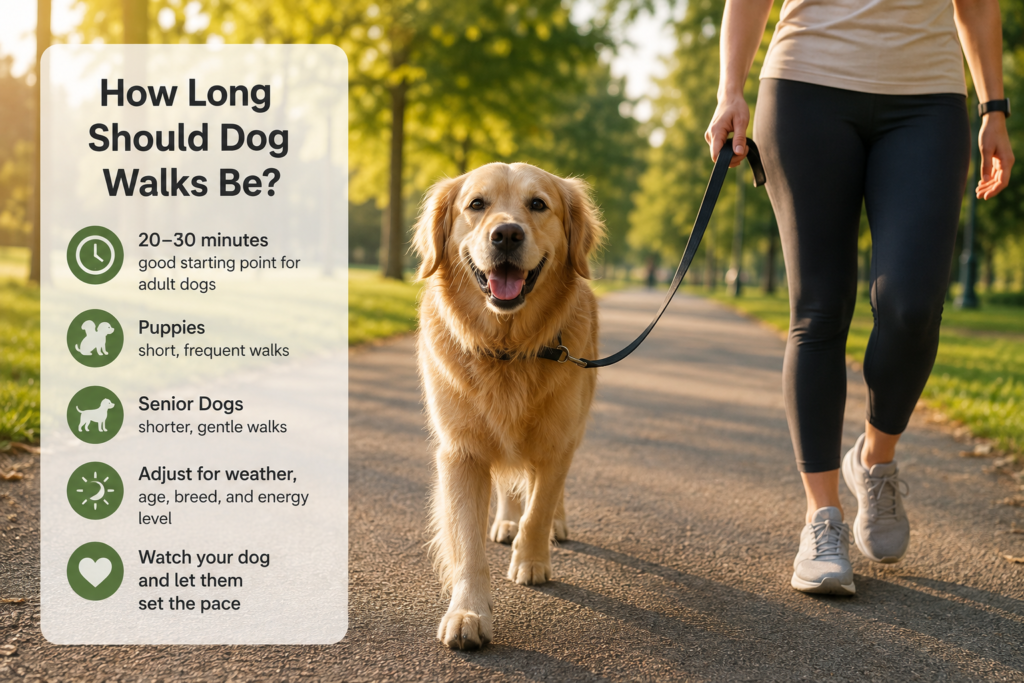
For many healthy adult dogs, a walk of around 20–30 minutes at a time can be a good starting point, while energetic dogs may comfortably enjoy much longer outings. Puppies and senior dogs often do better with shorter, more frequent walks.
But there isn’t one perfect number for every dog. Age, breed, health, fitness level, weather, and even the pace of the walk all matter. Veterinary guidance likewise emphasizes adapting exercise to the individual dog rather than following one fixed duration.
How Long Should You Walk Your Dog?
For a healthy adult dog, 20–30 minutes per walk is often a practical place to start. Some dogs may be perfectly happy with shorter walks, while active breeds may enjoy 45–60 minutes or more.
Instead of focusing only on the clock, watch your dog.
A comfortable walk should leave your dog pleasantly tired, not exhausted. If your dog is still energetic and eager to continue, they may be able to handle a little more. If they begin slowing down, lagging behind, lying down, or panting heavily, it may be time to head home.
And remember that walk length and total daily exercise aren’t exactly the same thing. Two shorter walks can sometimes be a better choice than one very long outing.
How Long Should You Walk a Puppy?
Puppies need exercise, exploration, and socialization, but longer isn’t necessarily better.
Their bodies are still developing, and they usually have less endurance than adult dogs. Short, frequent walks and play sessions are generally preferable to one long, strenuous walk.
A young puppy may only need a brief walk before becoming tired or distracted. As your puppy grows, you can gradually increase the distance and duration.
Walking is also mentally demanding for puppies. Every new smell, person, dog, sound, and environment gives them something to process, so even a short walk can provide plenty of stimulation.
If you’re unsure how much structured exercise is appropriate while your puppy is growing, ask your veterinarian.
How Long Should Adult Dogs Walk?
Healthy adult dogs usually have the greatest capacity for longer walks.
A moderately active adult dog might enjoy 20–30 minutes at a time, while energetic dogs may need longer walks combined with play, training, running, or other activities.
Breed can make a significant difference.
High-energy and working breeds often need considerably more activity than dogs bred primarily for companionship. However, breed alone shouldn’t determine the length of a walk. Two dogs of the same breed can have very different fitness levels and personalities.
If you’re also wondering how frequently those walks should happen, see our guide How Often Should You Walk Your Dog?
How Long Should You Walk a Senior Dog?
Senior dogs still benefit from regular walks, even when they can no longer cover the distances they once did.
For many older dogs, shorter and more frequent walks are easier than one long outing.
A senior dog might enjoy a gentle 10–20 minute walk, but there is no universal limit. Some healthy older dogs remain surprisingly active, while dogs with arthritis, heart conditions, or mobility problems may need much shorter outings.
Let your dog set the pace.
Watch for stiffness, limping, slowing down, reluctance to continue, excessive panting, or difficulty getting up after the walk. Regular gentle movement can help older dogs remain active, but exercise should be adjusted to their physical condition.
Does Dog Breed Affect Walk Length?
Yes, but perhaps not as simply as people sometimes think.
A Border Collie, Labrador Retriever, or Australian Shepherd may generally need more activity than a Pug or Chihuahua. But size doesn’t automatically tell you how much walking a dog needs.
Some small dogs are extremely energetic, while some very large breeds are surprisingly relaxed.
Consider your dog’s:
- Age
- Breed and genetics
- Energy level
- Health
- Weight
- Fitness level
- Personality
- Daily routine
The goal isn’t to reach a particular number of minutes. It’s to provide enough physical activity and mental stimulation for your individual dog.
Is a 30-Minute Walk Enough for a Dog?
For some dogs, absolutely.
A 30-minute walk can provide valuable physical exercise, mental stimulation, sniffing opportunities, and time with you.
For a highly energetic dog, however, one 30-minute walk may not provide enough activity for the entire day.
That doesn’t necessarily mean you need to turn every walk into an hour-long hike. You can combine walking with fetch, training, puzzle toys, scent games, or another walk later in the day.
If your dog still seems restless at home, our guide Signs Your Dog Is Bored can help you determine whether they may need more physical or mental stimulation.
Is a 1-Hour Walk Too Long for a Dog?
Not necessarily.
A fit, healthy adult dog accustomed to regular exercise may comfortably enjoy an hour-long walk. For another dog, an hour could be far too much.
The important part is building endurance gradually.
If your dog normally walks for 15 minutes, suddenly taking them on a strenuous 60-minute hike isn’t a great idea. Increase activity gradually and pay attention to how they behave both during the walk and afterward.
Does Sniffing Count as Exercise?
Definitely don’t rush every sniffing session.
A walk isn’t only about covering distance.
Sniffing allows dogs to investigate their environment and provides valuable mental stimulation. A slow 20-minute walk where your dog gets plenty of opportunities to sniff can sometimes be more enriching than marching quickly around the neighborhood for the same amount of time.
You don’t need every walk to be a workout.
Some can simply be sniff walks where your dog gets time to explore.
How Do You Know if a Walk Is Too Long?
Your dog will often give you clues.
Watch for:
- Falling behind
- Frequently stopping or lying down
- Excessive panting
- Limping
- Reluctance to continue
- Seeking shade
- Stiffness after returning home
- Unusual tiredness later in the day
- Sore or damaged paw pads
Don’t force your dog to continue simply because you planned a particular distance.
If your dog repeatedly struggles with walks they previously handled easily, especially without an obvious explanation, speak with your veterinarian.
What About Walking Dogs in Hot Weather?
Hot weather can completely change what would normally be an appropriate walk.
Dogs can overheat, and pavement can become dangerously hot for their paws. Puppies and senior dogs can also be particularly sensitive to temperature extremes.
On hot days, consider shorter walks during the cooler parts of the morning or evening and avoid strenuous activity during the hottest part of the day.
We’ll cover overheating in more detail in our guide Can Dogs Get Heatstroke?
Should Dogs Walk Every Day?
For most healthy dogs, regular daily walks are beneficial.
Walking provides much more than physical exercise. It gives dogs opportunities to sniff, explore different environments, experience new sights and sounds, and spend time with their owners.
Even dogs with access to a large yard can benefit from walks because a yard doesn’t provide the same variety of experiences and smells.
There may be exceptions for dogs recovering from surgery, dealing with illness or injury, or following exercise restrictions from a veterinarian.
FAQ
How long should a dog walk be?
For many healthy adult dogs, around 20–30 minutes can be a reasonable starting point. However, the ideal duration depends on the dog’s age, breed, health, fitness, and energy level.
Is 20 minutes enough to walk a dog?
It can be. A 20-minute walk may be plenty for some senior, small, or lower-energy dogs. More active dogs may need additional walks or other exercise during the day.
Is 30 minutes a good dog walk?
Yes. Thirty minutes can provide useful exercise and mental stimulation for many dogs, particularly when they’re allowed time to sniff and explore.
Can I walk my dog for an hour?
A healthy, fit adult dog accustomed to longer walks may comfortably walk for an hour. Increase duration gradually rather than suddenly introducing much longer walks.
Is it better to walk a dog once or twice a day?
Many dogs benefit from multiple opportunities to walk and explore throughout the day. The best schedule depends on the individual dog’s exercise needs and your daily routine.
Final Thoughts
So, how long should dog walks be?
There’s no perfect duration that works for every dog. Around 20–30 minutes can be a useful starting point for many healthy adult dogs, but your dog’s behavior is ultimately more important than the clock.
Puppies often need short outings, active adult dogs may enjoy much longer adventures, and senior dogs may benefit from shorter, gentler walks.
Give your dog opportunities to sniff, explore, and enjoy the walk—and adjust the duration when their age, fitness, health, or the weather changes.
This article is for informational purposes only and is not a substitute for professional veterinary advice. If you have concerns about your dog’s health or exercise needs, consult your veterinarian.