Your dog spots you from across the room and immediately starts wagging their tail. But how did they know it was you?
Was it your face? Your voice? The way you walk? Or simply your smell?
Dogs are remarkably good at recognizing familiar people, but they don’t necessarily identify us in exactly the same way humans recognize one another.
So, can dogs recognize faces?
Yes. Research suggests that dogs can distinguish familiar human faces, but facial recognition is only one part of a much bigger picture.
Can Dogs Recognize Human Faces?
Yes, dogs can recognize and distinguish human faces.
Studies of canine behavior and brain activity suggest that dogs pay attention to human facial information and can differentiate between familiar and unfamiliar people.
But dogs aren’t as dependent on faces as humans are.
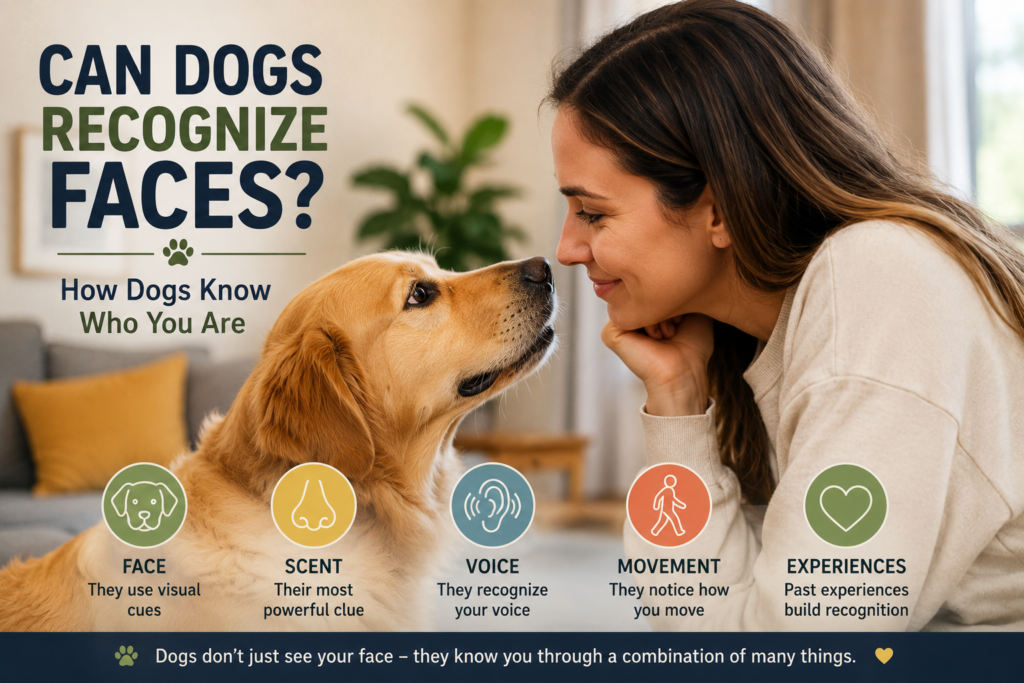
When we recognize someone, their face is often our most important clue. Dogs have access to something much more powerful — their sense of smell.
Your dog may combine your:
- Face
- Scent
- Voice
- Body shape
- Movement
- Walking style
- Behavior
Together, these clues create a very recognizable picture of you.
Do Dogs Recognize Their Owner’s Face?
Dogs can learn to recognize their owner’s face, particularly because they see that person regularly.
But your face probably isn’t the only reason your dog knows who you are.
Imagine approaching your dog in dim light where they can’t clearly see your face.
They may still recognize you almost immediately from your scent, voice, movement or even the sound of your footsteps.
Dogs are excellent at combining information from different senses.
So rather than thinking:
“That’s my owner because I recognize that face.”
Their recognition may be closer to:
“That looks, sounds, moves and smells like my person.”
Can Dogs Tell Familiar and Unfamiliar Faces Apart?
Dogs appear capable of distinguishing between familiar and unfamiliar people.
Familiar faces can attract their attention differently because they are associated with previous experiences.
But context matters.
A dog may react very differently to a familiar person wearing unusual clothing, approaching from an unexpected direction or behaving differently than usual.
Even then, scent and voice can provide additional clues.
Do Dogs Look at Our Faces?
Absolutely.
Dogs pay surprisingly close attention to humans.
They often look toward our faces when trying to understand what we’re doing or what might happen next.
Your facial expression can be part of the information your dog uses alongside your:
- Tone of voice
- Posture
- Hand movements
- Eye direction
- Overall behavior
This ability to pay attention to people is one reason dogs communicate with humans so effectively.
Can Dogs Understand Facial Expressions?
Dogs can respond differently to human emotional expressions.
That doesn’t necessarily mean they interpret every smile, frown or raised eyebrow exactly as another human would.
Instead, dogs likely combine facial information with other signals.
For example, imagine someone smiling while speaking in a friendly voice with relaxed body language.
Those signals all point in a similar direction.
Now imagine someone with a tense posture, loud voice and angry facial expression.
Again, the dog receives multiple clues at once.
So your face matters — but it’s part of a larger communication system.
Can Dogs Recognize Faces in Photos?
This gets a little more complicated.
Dogs can distinguish visual images presented on screens or photographs under experimental conditions, but recognizing a flat photograph isn’t identical to recognizing a real person standing nearby.
A photograph removes many of the clues dogs normally use.
There is:
- No familiar scent
- No movement
- No voice
- No normal body language
Some dogs may appear interested in a photograph of someone familiar, while others may show little reaction.
That doesn’t mean they don’t recognize the person in real life.
It simply means a photograph provides much less information.
Can Dogs Recognize People on TV?
Dogs can see people and animals on modern television screens.
Some dogs react strongly to what’s happening on TV, while others completely ignore it.
Whether your dog recognizes a particular person on television may depend on several factors, including image quality, movement, sound and familiarity.
We explain much more about how dogs perceive television in our guide Can Dogs Watch TV?
Does Color Vision Affect Facial Recognition?
Dogs don’t see the same range of colors that humans do.
They primarily distinguish colors in the blue and yellow ranges and have difficulty differentiating certain reds and greens.
But recognizing a face doesn’t depend entirely on color.
Dogs can use shapes, contrast, features and movement along with information from their other senses.
If you’re curious about how different the world may look to your dog, read our guide to what colors dogs can actually see.
Can Dogs Recognize Other Dogs’ Faces?
Dogs can distinguish between dogs and other species visually, and facial information may contribute to that recognition.
But once again, dogs have an enormous advantage that humans don’t have to the same degree: scent.
When two dogs meet in person, smell provides a huge amount of information.
That’s why recognizing another dog from a picture and recognizing them face-to-face aren’t necessarily the same task.
Do Dogs Remember Faces for a Long Time?
Dogs can retain memories and associations with familiar people over long periods.
However, it’s difficult to separate “remembering someone’s face” from remembering the entire person.
If a dog recognizes someone after a long absence, they may be responding to a combination of familiar scent, voice, appearance and behavior.
And sometimes the reaction is unmistakable — excitement, tail wagging, jumping or immediately approaching the person.
Why Does My Dog Stare at My Face?
Sometimes your dog isn’t simply recognizing you — they’re actively watching you for information.
Dogs learn that our faces and bodies can predict interesting things.
You look toward the door.
Maybe it’s walk time.
You look toward the food bowl.
Dinner could be coming.
You look directly at your dog.
Maybe they’re about to get attention.
Dogs can become incredibly skilled at observing these tiny everyday cues.
If your dog spends a surprising amount of time watching you, we have a full guide explaining Why Does My Dog Stare at Me?
Does My Dog Know What I Look Like?
Yes — but probably not in the purely visual way we might imagine.
Your dog knows far more than your face.
They know how you move through the house.
They know your footsteps.
They know your voice.
They know your routines.
And, most importantly, they know your scent.
Your face is one piece of a much larger collection of information that makes you instantly familiar.
FAQ
Can dogs recognize their owners by face?
Dogs can use facial information to recognize familiar people, but they also rely on scent, voice, movement and other cues.
Can dogs recognize faces in pictures?
Dogs can distinguish visual images, although a photograph lacks many important clues such as scent, movement and voice.
Can dogs recognize you on FaceTime?
Some dogs may respond to a familiar face or voice on a video call, while others show little interest. A small two-dimensional screen doesn’t provide the same sensory information as seeing you in person.
Do dogs remember people they haven’t seen for years?
Dogs can retain strong memories and associations with familiar people. Recognition after a long absence may involve scent, voice, appearance and previous experiences rather than facial recognition alone.
Does my dog know my facial expressions?
Dogs can respond to human facial expressions, particularly when combined with tone of voice and body language, although they don’t necessarily interpret them exactly as humans do.
Final Thoughts
So, can dogs recognize faces?
Yes. Dogs are capable of using facial information to distinguish and recognize people.
But your dog doesn’t need to rely on your face alone.
Your scent, voice, movements, body language and countless little behaviors all help them identify you.
That’s why your dog may recognize you before you’re even close enough for them to get a good look at your face.
To your dog, you’re much more than a familiar face — you’re a familiar combination of sights, sounds, smells and experiences they’ve learned incredibly well.
Disclaimer: This article is for informational purposes only and is not a substitute for professional veterinary advice.