
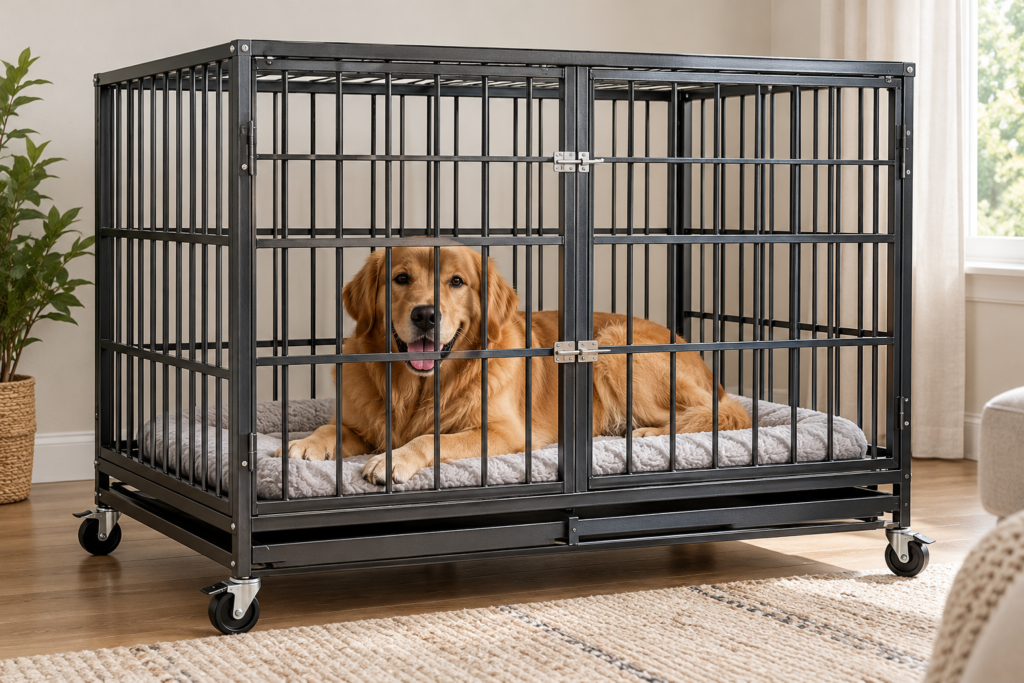
Finding the best escape-proof dog crates for anxious dogs in 2026 isn’t simply about buying the strongest metal cage you can afford. It’s about understanding why your dog keeps trying to escape—and whether a stronger crate is actually the right solution.
Some dogs are surprisingly good at opening ordinary crate latches. Others bend flimsy wire panels, push doors out of alignment, or discover exactly where a crate is weakest.
Then there are dogs who aren’t trying to outsmart anything. They’re frightened, overwhelmed, or desperate to get out.
Those situations may look similar when you come home to an empty crate, but they require very different approaches.
A reinforced dog crate can be a worthwhile investment for a dog who is comfortable being confined but needs a more secure enclosure. However, if your dog panics, bites the bars, or injures himself trying to escape, a stronger crate could make the situation more dangerous.
Before spending money on a heavy-duty kennel, let’s look at what matters, which options are worth considering, and how to choose a setup that keeps your dog both secure and comfortable.
Affiliate Disclosure: This article contains affiliate links. If you purchase through them, I may earn a small commission at no additional cost to you.
Before Buying: Is Your Dog Escaping or Panicking?
This is the most important question in the entire article.
A dog who calmly figures out how to slide a latch open is different from a dog who throws himself against the door because he cannot tolerate being confined.
Signs your dog may simply be escaping:
- He relaxes comfortably inside the crate when you’re home.
- He enters voluntarily and doesn’t appear frightened.
- He has learned how to open a particular latch.
- He settles normally in a more secure enclosure.
- He doesn’t show signs of distress before or during confinement.
Signs your dog may be experiencing distress:
- Persistent barking, howling, or whining.
- Frantic scratching or biting at the bars.
- Heavy panting or excessive drooling.
- Repeated attempts to force his way through the door.
- Injured paws, nails, teeth, or muzzle.
- Panic that begins when the crate door closes or when you prepare to leave.
These behaviors can have different causes, including separation-related distress or confinement anxiety.
If your dog is panicking or hurting himself, don’t respond by simply buying a stronger crate. Contact your veterinarian or a qualified veterinary behavior professional first.
For dogs who are comfortable in a crate but have defeated ordinary locking systems, the following heavy-duty options may be worth investigating.
10 Heavy-Duty Dog Crates to Consider in 2026
Not every crate on this list is suitable for every dog.
Some prioritize reinforced metal construction, others offer easier cleaning, and a few focus on portability or space-saving designs.
I’ve included different options so you can compare their construction and features rather than assuming that the most expensive or heaviest crate is automatically the safest.
Important: These are product comparisons based on listed features, not hands-on durability tests. No crate should be considered completely escape-proof.
1. Oranland 38 Inch Heavy Duty Dog Crate – Reinforced Metal Construction
The Oranland 38-inch heavy-duty crate is designed for owners looking for a more substantial alternative to a traditional wire kennel.
Its metal construction and reinforced design make it an option to investigate when an ordinary crate no longer provides adequate security for a dog who is otherwise comfortable being confined.
One feature worth examining closely is the base. A secure crate needs more than strong walls: the floor, door, and connecting points all need to remain stable when the dog moves around. What I like:
- Heavy-duty metal construction.
- Reinforced design.
- Wheels for easier repositioning.
- A more substantial structure than many basic wire crates.
What to consider:
- Heavier construction makes it less convenient to transport.
- Check the door and locking mechanism carefully.
- Confirm the interior dimensions before ordering.
Best for: Owners who want a reinforced indoor crate for a dog that is already comfortable with confinement.
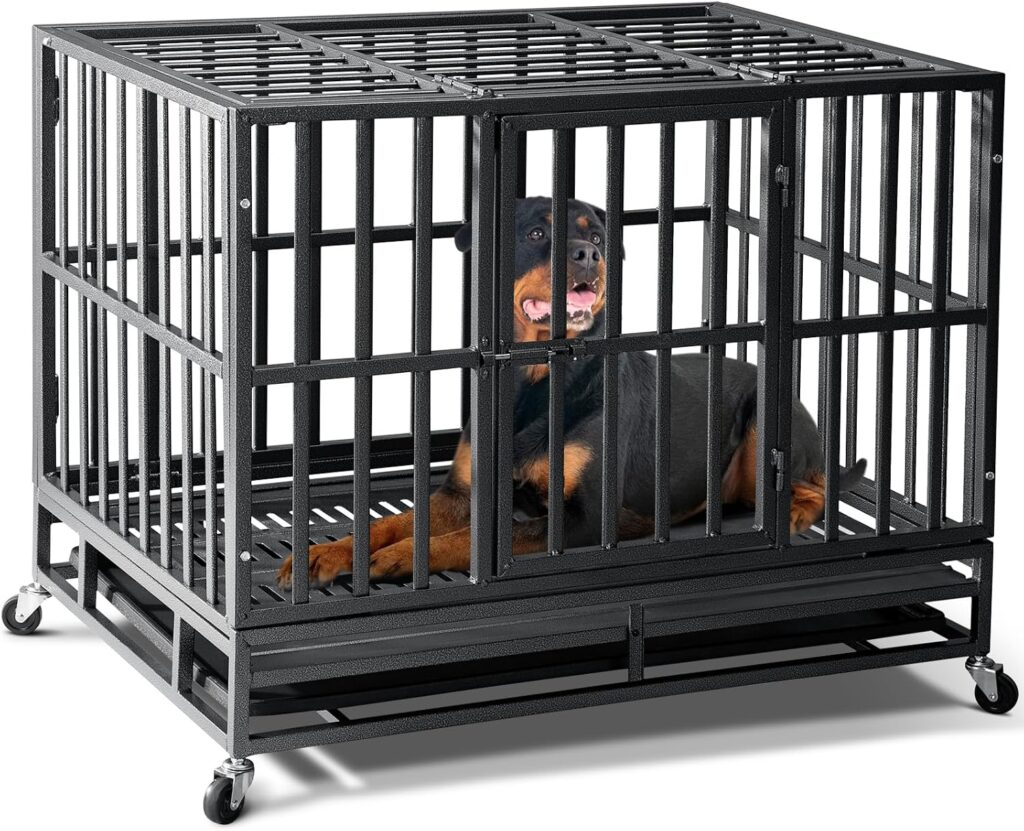
2. LUCKUP 38 Inch Heavy Duty Dog Cage – Sturdy Indoor Kennel
The LUCKUP 38-inch heavy-duty dog cage is another option for owners who prefer a substantial metal enclosure.
Its bar-style construction allows airflow and visibility, while the heavy-duty frame is intended to provide more resistance than a lightweight folding wire crate.
The removable tray is a practical feature, especially when you’re cleaning the crate regularly.
What I like:
- Heavy-duty metal frame.
- Open design for ventilation.
- Removable tray for cleaning.
- Wheels that can make moving the crate easier.
What to consider:
- Check the spacing between the bars.
- Make sure the door locks securely.
- The crate may be heavier and more difficult to store than a standard folding model.
Best for: Dogs that settle well in a crate but need a sturdier everyday enclosure.
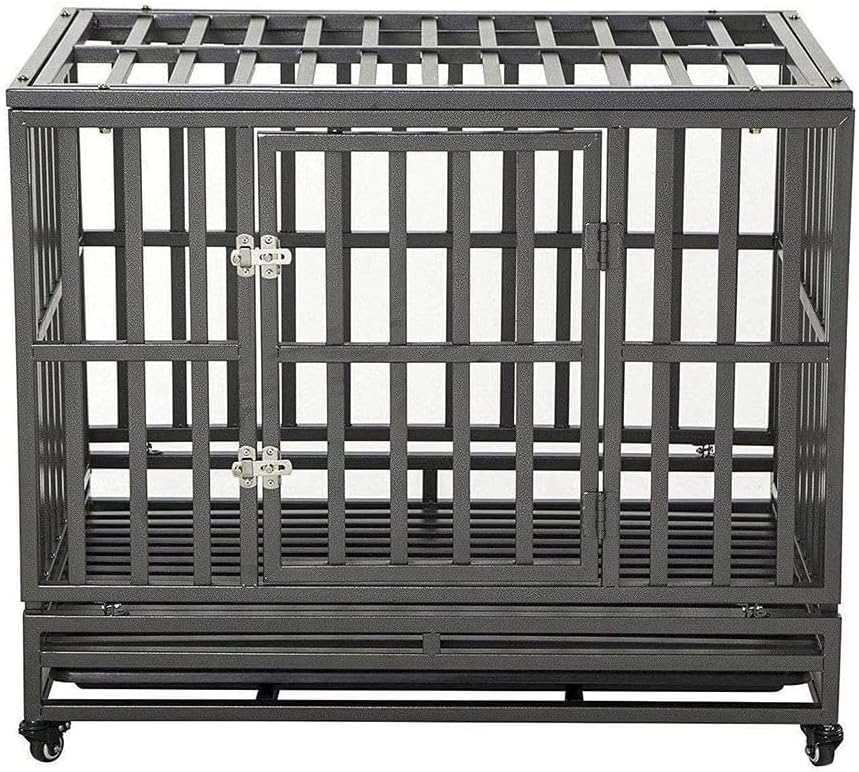
3. K9 Kennel Boss Heavy Duty Aluminum Dog Crate – Premium Construction
The K9 Kennel Boss takes a different approach from the traditional barred metal cage.
Its enclosed, reinforced design may appeal to owners who prefer a more substantial kennel with solid panels.
However, an enclosed design isn’t automatically better for an anxious dog. Some dogs enjoy a den-like space, while others become more distressed when their view is restricted.
Ventilation, temperature, interior space, and your dog’s individual preferences matter more than appearance.
What I like:
- Heavy-duty aluminum construction.
- More enclosed design.
- An alternative to conventional barred cages.
- Suitable for owners comparing premium kennel styles.
What to consider:
- Significantly more expensive than many alternatives.
- Check ventilation and temperature management.
- Verify interior measurements and intended use.
- An enclosed crate is not necessarily appropriate for a dog with confinement anxiety.
Best for: Owners seeking a premium reinforced kennel for a dog that already tolerates enclosed spaces comfortably.
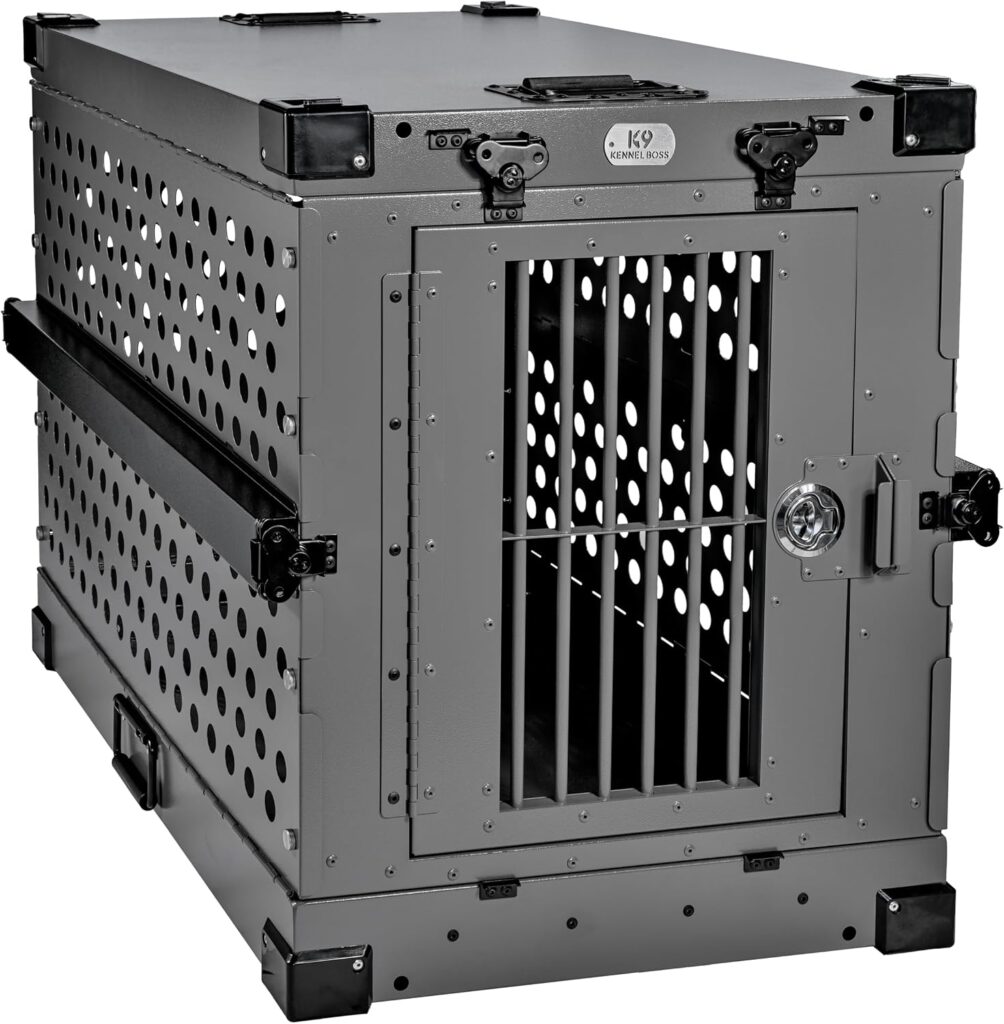
4. Snowuu 38 Inch Heavy Duty Dog Crate with Wheels – Practical Everyday Design
A heavy-duty crate doesn’t have to be complicated.
The Snowuu 38-inch model is worth considering if you want a reinforced indoor kennel with wheels that make it easier to reposition.
For everyday use, practical details can matter just as much as strength.
A crate that is difficult to clean, awkward to access, or uncomfortable for your dog may quickly become frustrating.
What I like:
- Heavy-duty construction.
- Wheels for moving the crate.
- Designed for indoor use.
- An alternative to more expensive reinforced models.
What to consider:
- Check whether the wheels lock securely.
- Inspect the door alignment and latch design.
- Compare interior dimensions with your dog’s measurements.
Best for: Owners who want a sturdy crate that can be moved around the home when needed.
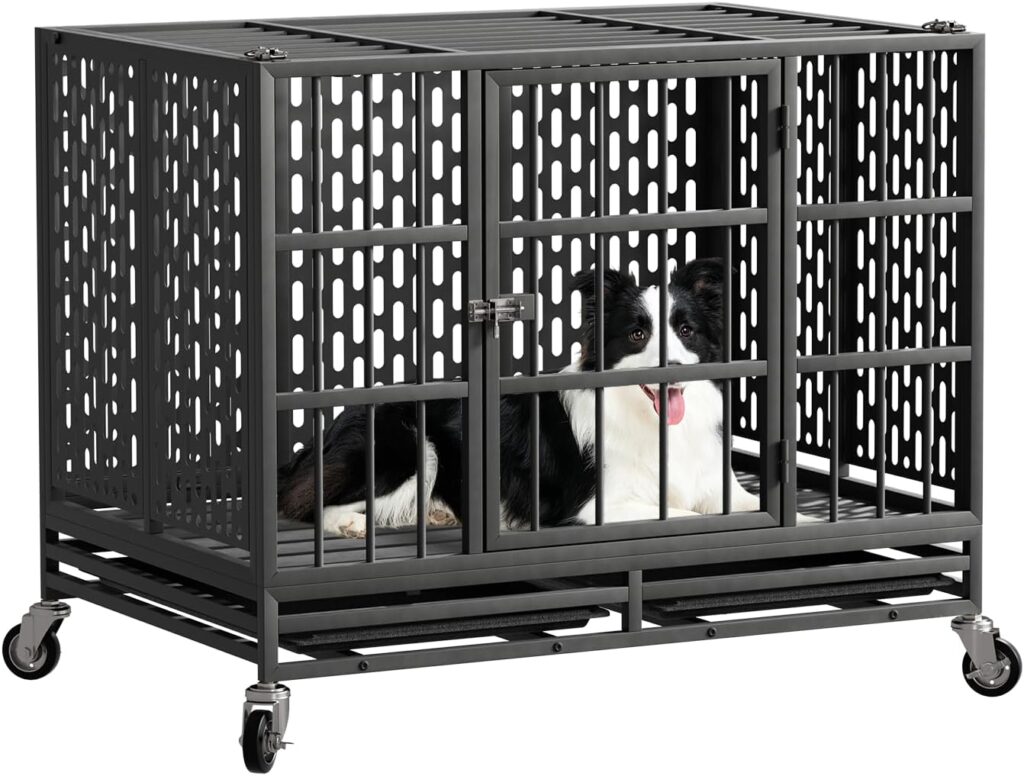
5. Pawaboo 38 Inch Heavy Duty Dog Crate – A More Affordable Option
If you’re comparing reinforced dog crates on a tighter budget, the Pawaboo 38-inch model is worth a look.
Its metal construction and removable tray offer some of the practical features buyers often look for in a heavy-duty crate.
However, affordability should never be the only deciding factor.
Pay particular attention to the latch, door hinges, bar spacing, and finishing around the edges.
What I like:
- More accessible price point than some premium crates.
- Metal construction.
- Removable tray.
- Straightforward indoor design.
What to consider:
- Inspect the locking system carefully.
- Check customer feedback about assembly and durability.
- Make sure the interior is large enough for comfortable movement.
Best for: Owners who want to compare budget-friendly reinforced crates without moving immediately into premium pricing.
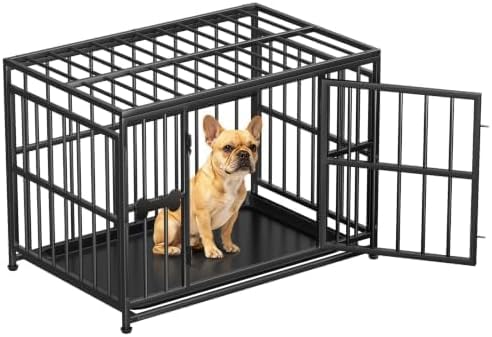
6. ProSelect Empire Cages – Medium – Heavy-Duty Steel Design
The ProSelect Empire Cage has a distinctly industrial appearance, with substantial steel bars and a wheeled base.
It’s designed for owners who want a stronger alternative to lightweight wire kennels.
One detail worth noting is that the product name includes Medium. That doesn’t mean it will fit every medium-sized dog.
A tall, narrow dog and a shorter, broad-chested dog may need very different interior dimensions.
What I like:
- Substantial steel construction.
- Heavy-duty appearance.
- Wheels for moving the crate.
- Removable tray.
What to consider:
- Compare the actual interior dimensions with your dog’s size.
- Check the door and locking points.
- Make sure the bar spacing is appropriate.
- Its weight and size may be inconvenient in smaller homes.
Best for: Owners looking for a substantial steel kennel who have enough space for a heavier indoor setup.
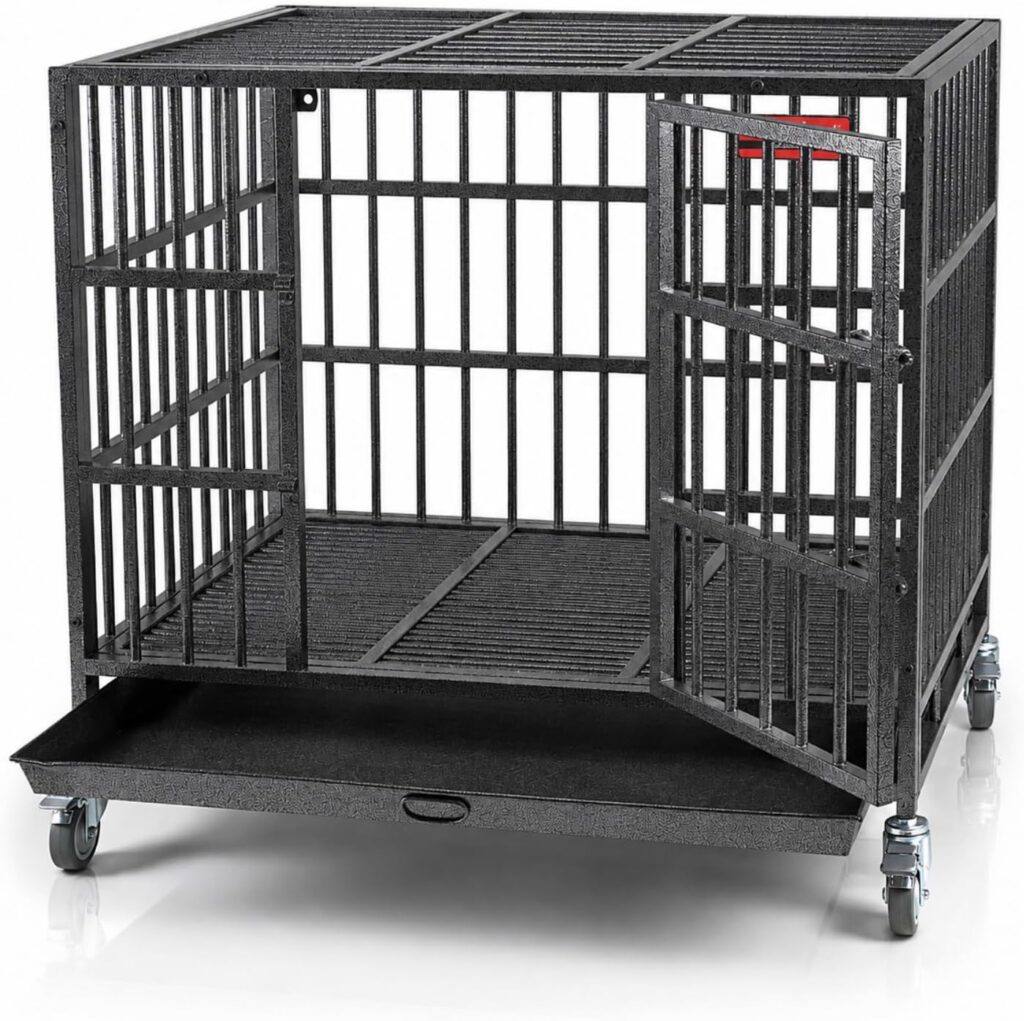
7. JY QAQA 38 Inch Heavy Duty Dog Crate – Double-Door Access
The JY QAQA heavy-duty crate stands out because of its double-door design.
Having more than one access point can make cleaning and arranging the crate easier, particularly when the enclosure is placed against a wall or in a corner.
However, additional doors also mean additional locking points that need to be checked.
A double-door design is useful only when both doors close securely.
What I like:
- Heavy-duty metal construction.
- Double-door access.
- Removable tray.
- Lockable wheels.
What to consider:
- Inspect both locking mechanisms.
- Make sure the top-opening design is secure.
- Check for gaps around doors and hinges.
- Never assume that a reinforced crate cannot be damaged.
Best for: Owners who value easier access and cleaning in a heavy-duty metal crate.
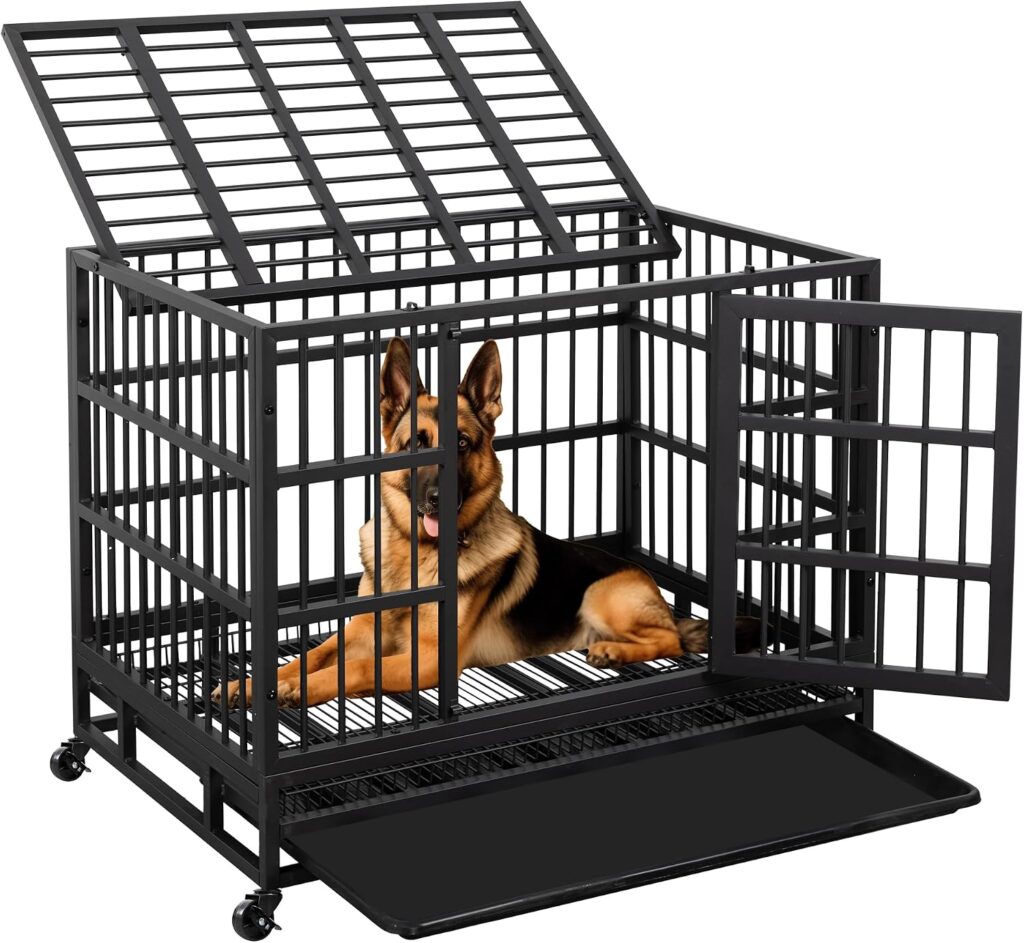
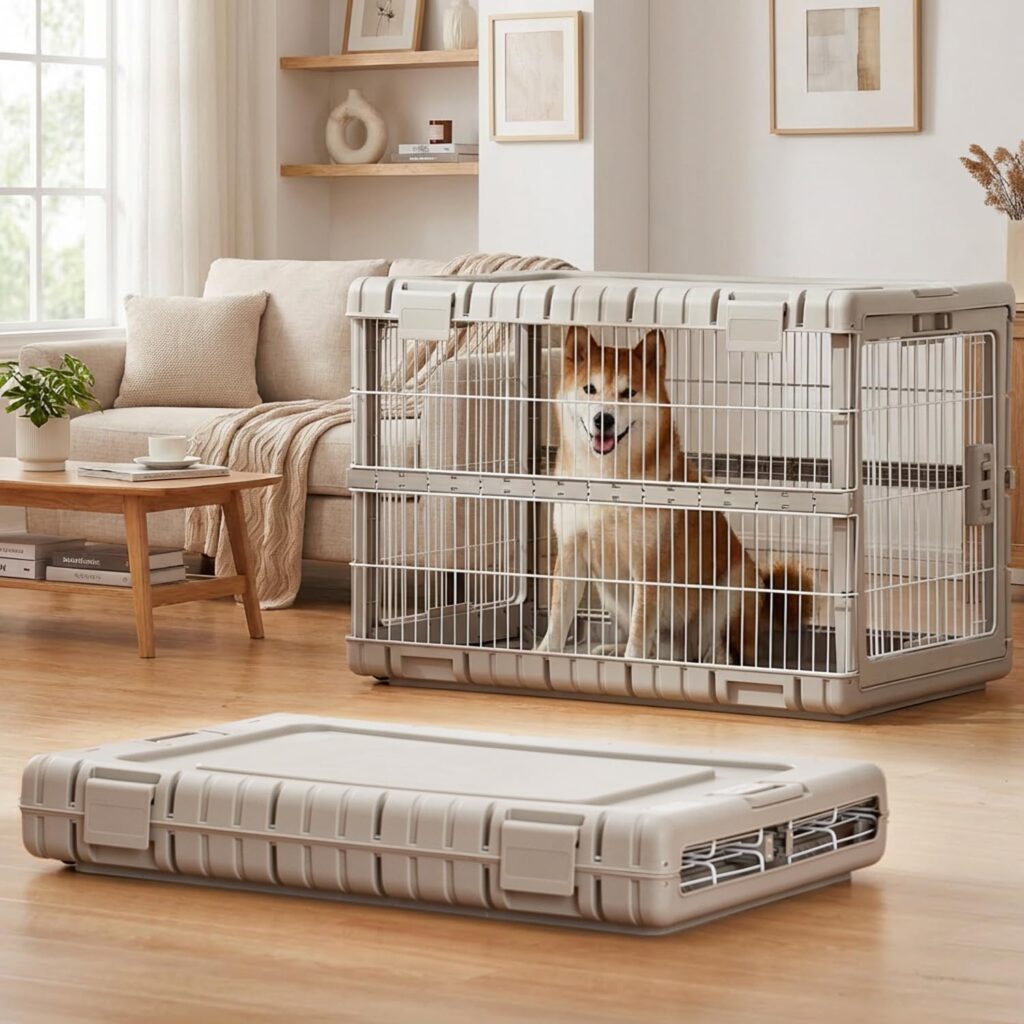
8. ZOMISIA 36-Inch Collapsible Heavy Duty Dog Crate – Space-Saving Design
Most heavy-duty crates aren’t particularly convenient to store.
That’s why the ZOMISIA collapsible model caught my attention.
Its foldable design may appeal to owners who occasionally need to move or store their dog’s crate rather than keeping a large metal structure permanently assembled.
However, folding mechanisms deserve extra attention.
Before using any collapsible crate, confirm that all sections lock securely into position and cannot shift during normal use.
What I like:
- Collapsible design.
- Wheels for mobility.
- Space-saving storage potential.
- A different option from permanently assembled metal cages.
What to consider:
- Inspect all folding joints and locking points.
- Check whether the crate remains stable when assembled.
- Confirm the interior dimensions.
- A collapsible design may not be the right choice for a dog that repeatedly forces crate panels.
Best for: Owners who need a sturdy crate but also value the ability to store it when not in use.
9. Lauren & Harold 38 Inch Heavy Duty Dog Crate – Front and Top Door Access
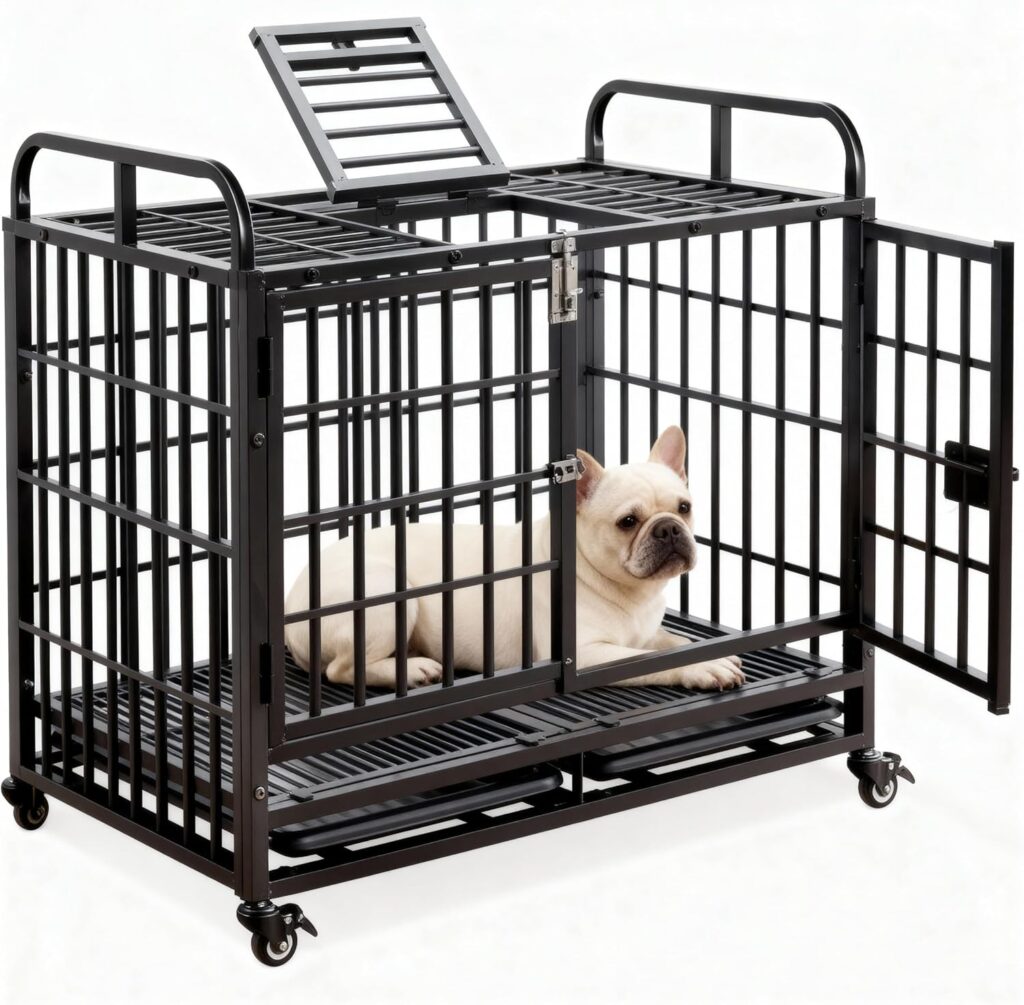
The Lauren & Harold 38-inch heavy-duty dog crate offers a practical alternative to traditional single-door kennels.
What makes this model interesting is its combination of a front door and a top-opening panel. The additional access can make cleaning and arranging the crate more convenient, especially when you’re working with a heavier metal enclosure.
It also features wheels and a removable tray, making everyday maintenance easier.
However, extra openings mean extra hinges and locking points. Before using this crate, make sure both doors close securely and that your dog has enough room to stand, turn around, and lie down comfortably.
What I like:
- Heavy-duty metal construction.
- Front and top door access.
- Wheels for easier repositioning.
- Removable tray for cleaning.
- An alternative to standard single-door crates.
What to consider:
- Check the security of both doors and their latches.
- Confirm the interior dimensions before ordering.
- Make sure the wheels are securely locked during use.
- Not suitable as a solution for dogs experiencing severe confinement anxiety or panic.
Best for: Owners who want a sturdy indoor crate with convenient access from both the front and top, for a dog that is already comfortable with confinement.
10. PawHut 48-Inch Heavy Duty Dog Crate – Best for Large Dogs
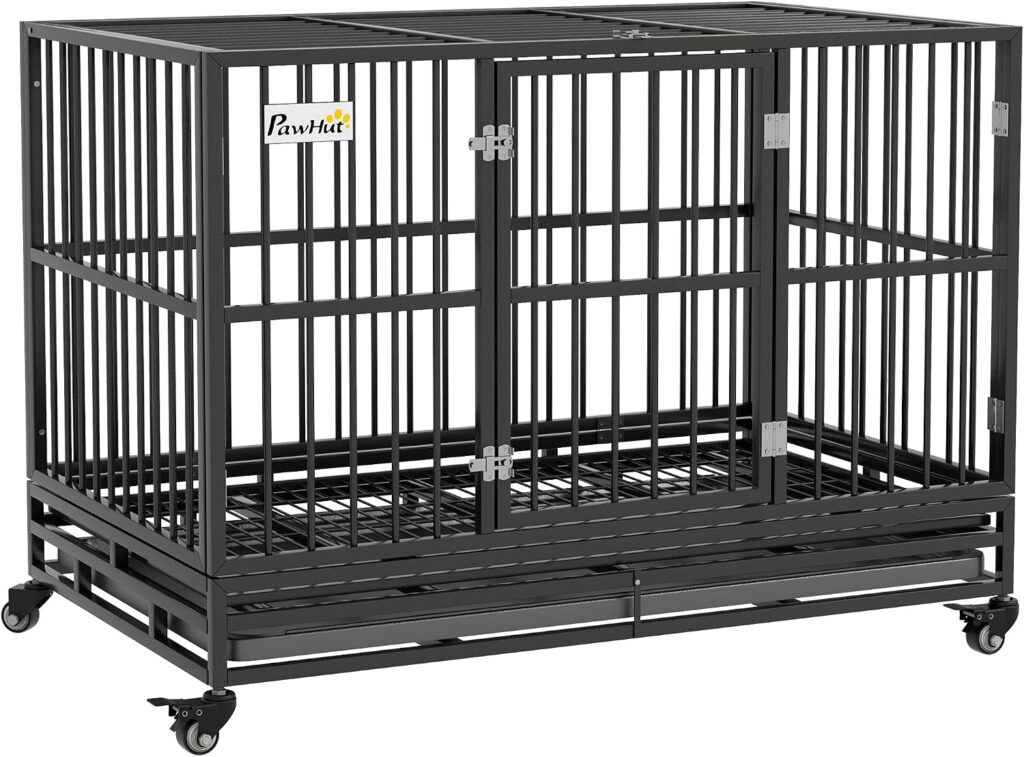
If you have a large, strong dog, finding a crate that offers enough space without compromising on durability can be challenging. The PawHut 48-Inch Heavy Duty Dog Crate is designed with a sturdy metal frame and a spacious interior, making it a practical option for larger breeds.
One of its most convenient features is the double-door design. The front and top openings make it easier to access your dog, especially when cleaning the crate or arranging bedding.
The crate also comes with four lockable wheels, allowing you to move it around your home without having to lift its heavy frame. A removable tray underneath helps make everyday cleaning more manageable. What I like:
- Spacious 48-inch design for larger dogs.
- Sturdy metal construction.
- Front and top doors for easier access.
- Lockable wheels for convenient movement.
- Removable tray for cleaning.
What to consider:
- Its large size requires plenty of floor space.
- The heavy construction makes it less suitable for frequent travel.
- Check the internal dimensions carefully to ensure your dog can stand, turn around, and lie down comfortably.
- Not every heavy-duty crate is suitable for dogs with severe separation anxiety or a history of injuring themselves while trying to escape.
Best for: Owners of large dogs who need a spacious, sturdy indoor crate with convenient access and easy cleaning.
What Makes a Heavy-Duty Dog Crate Worth Buying?
When you compare heavy-duty crates, it’s easy to focus on how thick the bars look.
But a good crate needs more than thick metal.
Here are the features I would pay attention to before buying.
1. Strong Construction Without Dangerous Edges
Look closely at the frame, joints, and welded connections.
The crate should feel stable, with no sharp edges or unfinished metal that could injure your dog.
A heavy crate isn’t automatically a well-built crate.
2. A Secure but Accessible Locking System
Some dogs learn to open simple sliding latches surprisingly quickly.
A reinforced locking system may be useful for dogs that have mastered ordinary crate doors.
However, you should always be able to open the crate quickly in an emergency.
Avoid improvising with chains, padlocks, or other modifications that could delay access to your dog.
3. Safe Bar Spacing
Wide gaps can create problems if a dog gets a paw, jaw, or muzzle caught between the bars.
This is particularly important for dogs that chew or pull at their crate.
If your dog has previously injured himself on crate bars, seek professional advice before choosing another barred enclosure.
4. Good Ventilation
A strong crate should still allow comfortable airflow.
Never place a crate in direct sunlight, next to a heater, or in an area where temperatures can become dangerously high.
More enclosed kennels require particular attention to ventilation and temperature.
5. Enough Room to Move Comfortably
Your dog should be able to:
- Stand naturally without crouching.
- Turn around comfortably.
- Lie down in a relaxed position.
- Change sleeping positions without difficulty.
Always check the interior dimensions, not just the size printed in the product title.
6. A Stable Base and Secure Wheels
Wheels are convenient when moving a heavy crate, but they must not allow it to shift unexpectedly.
Check that the brakes work properly and the base remains stable.
7. Easy Cleaning
A removable tray can make everyday cleaning easier.
Just make sure the tray fits properly and doesn’t create gaps or sharp edges.
Regular Wire Crates vs. Heavy-Duty Dog Crates
A regular wire crate may be perfectly suitable for a calm, crate-trained dog.
You don’t necessarily need an expensive reinforced enclosure simply because your dog is large.
Regular wire crates are often better when:
- Your dog is comfortable with confinement.
- He doesn’t interfere with the door or latches.
- You want something lightweight.
- You need a crate that folds for storage.
- Budget is an important consideration.
Heavy-duty crates may be worth considering when:
- Your dog has learned to open ordinary latches.
- A lightweight crate is no longer structurally suitable.
- Your dog remains relaxed while confined.
- You need a sturdier enclosure for everyday use.
- You’re prepared for a heavier, more expensive setup.
Neither option is appropriate when:
- Your dog panics when confined.
- He repeatedly bites or throws himself against the bars.
- He has injured himself attempting to escape.
- Confinement causes severe distress.
In those situations, the priority should be identifying and addressing the underlying problem.
Can an Escape-Proof Dog Crate Help With Separation Anxiety?
A stronger crate does not treat separation anxiety.
This distinction matters because the phrase escape-proof dog crate for anxious dogs can make it sound as though stronger construction is the answer to anxiety.
It isn’t.
Dogs with separation anxiety may become distressed when separated from their owners. Some also experience confinement anxiety, meaning the crate itself makes them uncomfortable or frightened.
A dog who is already panicking may continue trying to escape even when the enclosure is stronger.
That can lead to damaged teeth, torn nails, or other injuries.
Depending on the dog, appropriate support may include:
- A veterinary examination.
- A behavior assessment.
- Gradual, reward-based behavior modification.
- A safer confinement alternative.
- A pet sitter or another temporary management arrangement.
- Medication when prescribed by a veterinarian.
If your dog struggles specifically when left alone, you may also find our guide How to Keep a Dog Entertained While Home Alone useful for general enrichment ideas.
However, enrichment toys alone are not a treatment for separation anxiety.
How to Choose the Right Crate Size
Crate sizing deserves more attention than it usually gets.
Two dogs can weigh exactly the same but need completely different crate dimensions.
A long-bodied dog may need more floor space, while a taller dog may need additional headroom.
Measure your dog’s length
Measure from the tip of the nose to the base of the tail while your dog is standing naturally.
Choose an interior length that allows him to lie down and reposition comfortably.
Measure your dog’s height
Measure from the floor to the highest point of his head or ears, whichever is relevant to his natural standing posture.
Your dog shouldn’t need to lower his head to stand inside.
Check the door opening
A spacious interior won’t help if your dog has to squeeze awkwardly through the entrance.
Make sure the opening is large enough for comfortable entry and exit.
Don’t rely on breed recommendations alone
Manufacturers sometimes list suitable breeds, but individual dogs vary.
Use your dog’s actual measurements as the deciding factor.
How to Help Your Dog Feel Comfortable in a Crate
Even the best-built crate won’t be useful if your dog dislikes being inside it.
For dogs that are not experiencing panic or severe confinement distress, gradual positive-reinforcement training can help create a more comfortable association.
Start with the door open
Place the crate in a quiet part of your home.
Let your dog explore it voluntarily.
You can place treats near the entrance and gradually farther inside.
Never push or force him into the crate.
Reward relaxed behavior
When your dog enters voluntarily, reward him.
The goal is for him to associate the crate with comfort and positive experiences.
Introduce the door gradually
Once your dog is comfortable resting inside, practice closing the door briefly while you’re nearby.
Open it before he becomes distressed.
If he shows discomfort, return to an easier step.
Practice while you’re home
Don’t make the first closed-door experience a long absence.
Build comfort gradually, at your dog’s pace.
Never use the crate as punishment
A crate should be a place where your dog can relax, not somewhere he is sent when you’re angry.
If your dog begins panicking, stop the exercise and seek qualified guidance.
What to Do If Your Dog Keeps Escaping His Crate
Before buying a replacement, try to understand exactly what happens.
Look for patterns
Ask yourself:
- Does your dog escape only when you’re away?
- Does he become distressed as soon as the door closes?
- Is he calm in the crate while you’re home?
- Does he escape even after exercise and a bathroom break?
- Is he opening the latch, or physically damaging the crate?
These details can help identify the problem.
Consider using a pet camera
A camera can sometimes reveal whether your dog settles comfortably before escaping or becomes distressed immediately.
However, don’t leave a dog in a situation where he may injure himself simply to record what happens.
Check for injuries
After an escape, examine your dog’s paws, nails, mouth, and face.
Some injuries aren’t immediately obvious.
Contact your veterinarian if you notice bleeding, limping, broken nails, dental damage, or unusual behavior.
Consider a different setup
Some dogs do better in a safely dog-proofed room or another professionally recommended environment.
Check for electrical cords, toxic substances, objects that could be swallowed, and other household hazards.
The safest solution isn’t always another crate.
Common Mistakes to Avoid When Buying a Heavy-Duty Dog Crate
Buying the strongest crate without understanding the problem
If your dog is frightened, stronger bars won’t remove that fear.
Trusting the word “indestructible”
No manufacturer can guarantee that every dog will be unable to damage or escape a particular enclosure.
Ignoring the interior dimensions
A crate can look enormous in product photos but still be uncomfortable for your dog.
Overlooking the locking system
Strong bars won’t help if the door can be opened easily.
Forgetting about ventilation
A reinforced enclosure still needs adequate airflow.
Leaving a dog alone in a new crate immediately
Even if your dog has used a different crate before, allow time to become familiar with the new one.
Assuming expensive means safer
Price and weight alone don’t determine whether a crate is suitable for your dog.
Frequently Asked Questions
What is the best escape-proof dog crate for an anxious dog?
It depends on why the dog is escaping. A dog who is comfortable with confinement but opens ordinary latches may benefit from a properly sized reinforced crate. A dog who panics, bites bars, or injures himself needs veterinary or qualified behavioral guidance before another crate is considered.
Are heavy-duty dog crates worth the money?
They can be worthwhile when you need stronger construction, more secure latches, or a sturdier everyday enclosure. However, they aren’t necessary for every dog, and they don’t treat anxiety.
Can dogs escape from heavy-duty crates?
Yes. No crate is guaranteed to be escape-proof. Some dogs may damage the structure or injure themselves trying to get out.
Are metal crates better than plastic crates?
Neither is universally better. Metal crates often offer visibility and airflow, while some plastic kennels provide a more enclosed environment. The best choice depends on the dog’s size, behavior, comfort, and the specific product’s construction.
Are double-door dog crates safer?
Not necessarily. Double doors can improve access, but they also introduce additional hinges and locking points. Both doors need to close securely.
Should I put a bed inside a heavy-duty crate?
If your dog uses bedding safely, a comfortable bed or mat may make the crate more inviting. However, if your dog shreds or swallows fabric, ask your veterinarian about safer options.
How long can a dog stay in a crate?
There isn’t one appropriate duration for every dog. Age, health, bladder needs, activity level, and comfort all matter. Puppies generally need more frequent breaks, and no dog should spend prolonged periods confined without appropriate opportunities for exercise, interaction, and toileting.
Can crate training cure separation anxiety?
No. Crate training can help some dogs feel comfortable in a crate, but separation anxiety requires an approach that addresses the dog’s distress about being alone. Some dogs with separation anxiety become more distressed when confined.
What if my dog hurts himself trying to escape?
Stop using that confinement setup and contact your veterinarian. Repeated attempts that cause injuries should be assessed by a qualified professional rather than managed by simply purchasing a stronger crate.
Final Thoughts
Choosing the best escape-proof dog crate for your dog means looking beyond thick metal bars and impressive product descriptions.
A reinforced crate can be a practical upgrade when your dog is comfortable being confined but needs a more secure enclosure.
But if your dog is frightened, panicking, or injuring himself while trying to escape, a stronger crate isn’t the solution.
Before buying, think about your dog’s behavior, measure carefully, inspect the locking system, and choose a design that allows him to rest comfortably.
The goal isn’t simply to keep your dog inside.
It’s to help him feel safe while he’s there.
Has your dog ever figured out how to escape a crate? Share your experience in the comments.
Disclaimer: This article is intended for general educational purposes and does not replace professional veterinary or behavioral advice. If your dog experiences severe anxiety, panic, or self-injury during confinement, consult your veterinarian or a qualified veterinary behavior professional.