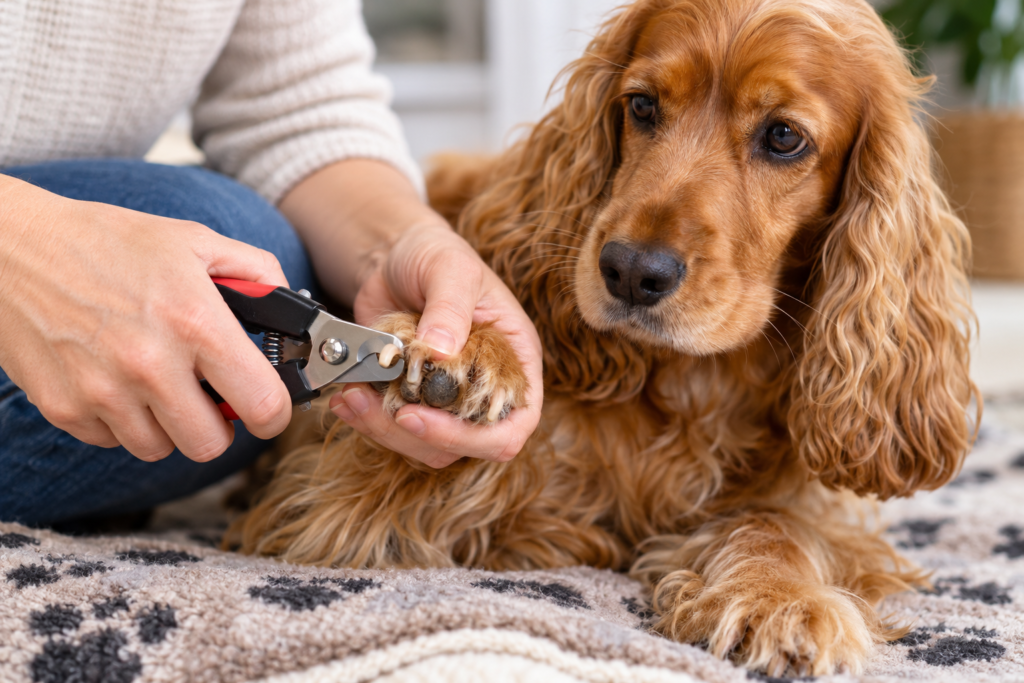
If you’re wondering how to trim dog nails when your dog won’t stay still, you’re not alone. Even a simple nail trim can turn into a challenge when your dog keeps pulling their paws away, twisting around, or refusing to cooperate.
I know it from my own cocker spaniel. Nail trimming isn’t exactly his favorite part of dog care, and getting him to stay still takes patience. The more you try to rush through it, the harder the whole process can become.
One thing I’ve learned is that you don’t necessarily have to trim every nail in one sitting. Sometimes getting one or two nails done calmly is a much better result than struggling through all four paws.
If your dog squirms, pulls away, or simply refuses to cooperate, here’s how to make nail trimming safer, calmer, and a little easier for both of you.
Disclosure: This post may contain affiliate links. If you buy through them, I may earn a small commission at no extra cost to you.
Why Won’t My Dog Stay Still for Nail Trimming?
A dog that won’t stay still isn’t necessarily being stubborn.
There are plenty of reasons dogs dislike nail trims:
- They don’t like having their paws handled
- The clippers or grinder look, sound, or feel scary
- They’ve had an unpleasant nail trim before
- They dislike being restrained
- Their paws, nails, or joints may be uncomfortable
- They simply haven’t learned what to expect
Pay attention to what happens before your dog starts really struggling.
You may notice them pulling a paw away, turning toward your hand, licking their lips, yawning, repeatedly standing up, or trying to leave.
Those smaller signals matter.
If you keep pushing until your dog is desperately trying to escape, the next nail trim may be even harder.
Quick Fixes for Common Nail-Trimming Problems
| If your dog… | Try this |
|---|---|
| Pulls their paw away | Let go, pause, and try again when they’re calmer |
| Is afraid of the clippers | Introduce the clippers with treats without trimming |
| Hates the clipping sensation | Gradually introduce a nail grinder |
| Hates the grinder noise | Try traditional nail clippers |
| Slips or squirms | Use a stable, non-slip surface |
| Gets impatient quickly | Trim only one or two nails at a time |
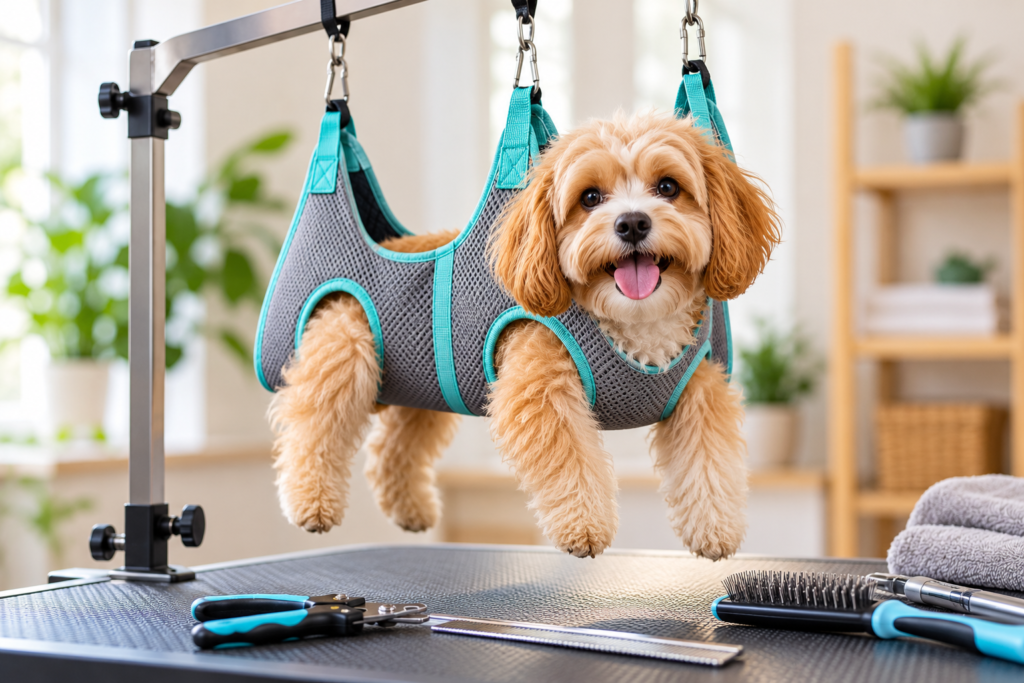
| Twists or keeps sitting down | A properly fitted grooming hammock may help some dogs |
| Growls, snaps, or tries to bite | Stop and get professional help |
The trick is figuring out what part of nail trimming your dog dislikes rather than assuming every restless dog needs the same solution.
How to Trim a Dog’s Nails When They Won’t Stay Still
1. Start With Paw Handling
Before you even bring out the nail clippers, work on getting your dog comfortable with having their paws touched.
And do this at a completely different time from the actual nail trim.
When your dog is relaxed:
- Touch a leg and reward
- Touch a paw and reward
- Hold the paw briefly and reward
- Gently touch individual toes and reward
- Gradually hold the paw for a little longer
You don’t need a long training session.
A minute or two is enough.
The idea is simple: your dog should learn that having their paws touched doesn’t always mean the nail clippers are coming next.
2. Bring Out the Clippers Without Using Them
If your dog disappears as soon as the grooming tools come out, the tool itself may already be part of the problem.
So change what it means.
Bring out the clippers, let your dog see them, offer a treat, and put them away.
No nail trimming.
You can gradually bring the clippers closer to a paw while continuing to reward calm behavior.
A nail grinder requires an extra step because of the sound and vibration.
Turn it on at a distance where your dog is still comfortable. Over several short sessions, you can gradually bring it closer.
Don’t rush from “my dog tolerates the sound” to immediately trying to grind a nail.
3. Choose the Right Place
Where you trim your dog’s nails can make a difference.
A slippery floor certainly doesn’t help a dog who is already uncomfortable.
Choose a quiet spot and use a stable, non-slip surface such as a rubber-backed rug or mat.
Before you start, have everything within reach:
- Nail clippers or grinder
- Small treats
- Styptic powder
- Good lighting
- A non-slip mat or surface
Getting everything ready beforehand means you don’t have to stop halfway through while your dog is already waiting.
4. Forget About Finishing All the Nails
This is probably one of the most useful things to remember with a dog that won’t stay still:
You don’t have to finish every nail today.
Trim one nail.
Give your dog a reward.
And if that was enough for your dog, stop.
You can do another one tomorrow.
It might take several days to finish all the nails, but that can be much easier than turning one grooming session into a wrestling match.
As your dog gets more comfortable, you may find that one nail becomes two, then a whole paw.
5. Reward the Calm Moments
Don’t wait until the entire nail trim is finished before giving your dog something good.
Reward the behavior you want as it happens.
That might mean giving a small treat for:
- Letting you touch a paw
- Allowing you to hold a toe
- Staying calm when the clippers appear
- Letting the tool touch a nail
- Successfully trimming one nail
Small treats work well because you can use several throughout the process.
For a dog that finds nail trimming difficult, those little positive moments can matter more than getting the whole job done quickly.
6. Trim Small Amounts
Inside each nail is the quick, which contains blood vessels and nerves.
Cutting into it can hurt and cause bleeding.
On light-colored nails, the quick is often easier to see. Dark nails are more difficult, so taking off small amounts at a time is especially important.
If you’re not confident about how much nail you can safely remove, don’t guess.
A veterinarian, veterinary technician, or professional groomer can show you where and how to trim.
Leaving the nail slightly longer is better than cutting farther when you aren’t sure.
Clippers vs. Nail Grinder: Which Is Better?
This is one of those questions where the answer really is: it depends on your dog.
Nail Clippers
Advantages:
- Fast
- Quiet
- Simple to use
- Each nail can be finished quickly
Possible downside:
Some dogs dislike the pressure and clipping sensation, and you need to be careful not to remove too much nail at once.
Nail Grinder
Advantages:
- Removes small amounts gradually
- Gives you more control
- Can smooth rough nail edges
Possible downside:
The noise and vibration can frighten some dogs, and grinders need to be used carefully to avoid creating too much heat or catching long fur.
A grinder isn’t automatically better just because your dog hates clippers.
Some dogs dislike the grinder even more.
Use whichever tool your dog tolerates most comfortably and safely.
If you’re putting together your grooming supplies, take a look at our Best Dog Grooming Kits in 2026 for more useful at-home grooming tools.
Can a Dog Grooming Hammock Help With Nail Trimming?
For some dogs, yes.
A grooming hammock supports the dog’s body while leaving the paws accessible. It can be helpful for some smaller dogs that constantly twist, sit down, or pull their legs away during grooming.
But there’s an important difference between supporting a dog and forcing a frightened dog to submit to a nail trim.
A grooming hammock should be the correct size, properly secured, and used according to the manufacturer’s instructions.
If your dog panics, thrashes, appears uncomfortable, or has difficulty breathing, stop immediately.
If you’re considering a grooming hammock, look for one that fits your dog’s size and weight, provides comfortable support, and can be securely attached. Always follow the manufacturer’s instructions and never leave your dog unattended in a hammock.
What If My Dog Keeps Pulling Their Paw Away?
This is probably one of the most familiar problems for anyone who trims their dog’s nails at home.
You take the paw.
Your dog takes it back.
Instead of immediately grabbing it again and holding more tightly, let go for a moment.
Give your dog a short break and try again when they’re calmer.
If it happens every single time, go back to practicing paw handling without doing any trimming.
For a few days, the entire “nail trimming session” might simply be:
Touch paw. Treat. Done.
It can feel like you aren’t making progress because no nails are actually getting shorter.
But if your dog becomes more comfortable with having their paws handled, you’re working on the part that was preventing you from trimming them in the first place.
What If My Dog Tries to Bite?
This is where I would stop trying to finish the nail trim.
Growling, snapping, or biting is different from a dog simply pulling a paw away or getting impatient.
Don’t respond by holding your dog more forcefully.
There’s also another reason to take a sudden change seriously.
If your dog previously allowed you to handle their paws but suddenly reacts strongly—especially when you touch one particular paw, toe, or nail—there could be pain or an injury involved.
In that situation, talk to your veterinarian.
For a dog that is extremely frightened or has a history of biting during grooming, a veterinarian or experienced professional groomer is the safer option.
What If You Accidentally Cut the Quick?
Even when you’re careful, accidents can happen.
If you cut a nail too short and it starts bleeding:
- Stay calm.
- Apply styptic powder to the nail.
- Apply gentle pressure.
- Give your dog a break.
If the bleeding is heavy, doesn’t stop, or the nail appears damaged, contact your veterinarian.
And don’t feel that you need to finish the remaining nails immediately.
If your dog has just had an unpleasant experience, stopping for the day may make the next attempt easier than trying to rush through the rest.
How Often Should You Trim Your Dog’s Nails?
There isn’t one schedule that works for every dog.
How quickly nails grow and wear down depends on the dog, their activity level, and the surfaces they regularly walk on.
A dog that spends a lot of time walking on harder surfaces may naturally wear their nails more than a dog that spends most of their time on softer ground.
Rather than relying only on a calendar, check your dog’s nails regularly.
We go into much more detail in How Often Should You Trim Dog Nails?, including what to look for and how to tell when it may be time for another trim.
How to Make the Next Nail Trim Easier
One mistake is forgetting about your dog’s paws completely once the nails are done.
Instead, make paw handling part of normal life.
Every now and then:
- Touch and briefly hold a paw
- Gently handle individual toes
- Reward your dog for staying relaxed
- Bring out the clippers without using them
- Keep the interaction short
If the clippers appear only when something your dog dislikes is about to happen, it’s not surprising if they learn to react as soon as they see them.
Making both paw handling and grooming tools less unusual can make the next nail trim easier.
When Should You Let a Professional Trim Your Dog’s Nails?
There’s nothing wrong with deciding that a particular nail trim is beyond what you can comfortably do at home.
Consider getting help from a groomer or veterinary professional if:
- Your dog becomes extremely distressed
- Your dog growls, snaps, or tries to bite
- You can’t safely control their movement
- Their nails are severely overgrown
- A nail is broken or injured
- Your dog appears painful when a paw is touched
- You’re unsure where it’s safe to cut
Sometimes getting professional help is much better than turning every nail trim into a stressful experience for both you and your dog.
FAQ
How do I trim my dog’s nails if they won’t stay still?
Start smaller than you think you need to. Practice touching and holding the paws without trimming, introduce the clippers or grinder gradually, and reward calm behavior. When you start trimming, doing just one or two nails at a time is completely fine.
Can I trim just one dog nail a day?
Yes. There’s no reason you have to trim every nail during one session. For a dog that finds nail trimming stressful, spreading the job over several short sessions can be much easier.
Should I hold my dog down to cut their nails?
Avoid turning nail trimming into a physical struggle. Gentle positioning may be necessary, but if your dog is panicking or needs to be forcefully restrained, stop and consider getting help from a professional.
Is a nail grinder better than clippers for a nervous dog?
Not necessarily. Grinders remove nail gradually, but their sound and vibration bother some dogs. Clippers are quieter and faster, but some dogs dislike the clipping sensation. The better option is the one your dog tolerates safely.
Why does my dog suddenly hate having their nails trimmed?
If your dog used to tolerate nail trimming and suddenly reacts badly, consider whether a nail, paw, or joint may be painful. A strong reaction to one particular area is worth discussing with your veterinarian.
What can I give my dog to calm them for nail trimming?
Don’t give your dog medications, supplements, or sedatives simply to make nail trimming easier without first discussing them with your veterinarian. For mild nervousness, start with shorter sessions, treats, gradual handling, and getting your dog comfortable with the grooming tools.
Do dog grooming hammocks work for nail trimming?
They can help some dogs, particularly smaller dogs that twist, sit down, or constantly move during nail care. They aren’t suitable for every dog and shouldn’t be used to force a panicked dog through a trim.
What should I do if I cut my dog’s nail too short?
Apply styptic powder and gentle pressure to help stop the bleeding. Give your dog a break rather than immediately continuing the trim. Contact your veterinarian if bleeding is heavy, doesn’t stop, or the nail appears injured.
Final Thoughts
Having a dog of my own has taught me that everyday care doesn’t always go as neatly as the instructions make it sound.
Sometimes your dog simply isn’t interested in cooperating—and nail trimming can definitely be one of those moments.
If your dog won’t stay still, don’t make finishing all four paws the only measure of success.
Start with getting them comfortable with having their paws touched. Introduce the tools slowly. Keep the actual trimming sessions short, and don’t be afraid to stop after one or two nails.
A calmer one-nail session today can be more useful than forcing your way through every nail and making your dog dread the next trim even more.
And if your dog is extremely frightened, aggressive, or appears to be in pain, leave the nail trim to a veterinarian or professional groomer.
The goal isn’t simply to get the nails shorter. It’s to find a way to keep routine nail care as safe and manageable as possible—for your dog and for you.
Disclaimer: This article is for general informational purposes only and is not a substitute for professional veterinary advice. Contact your veterinarian if your dog shows signs of pain, extreme fear or aggression, or has a nail or paw injury.