
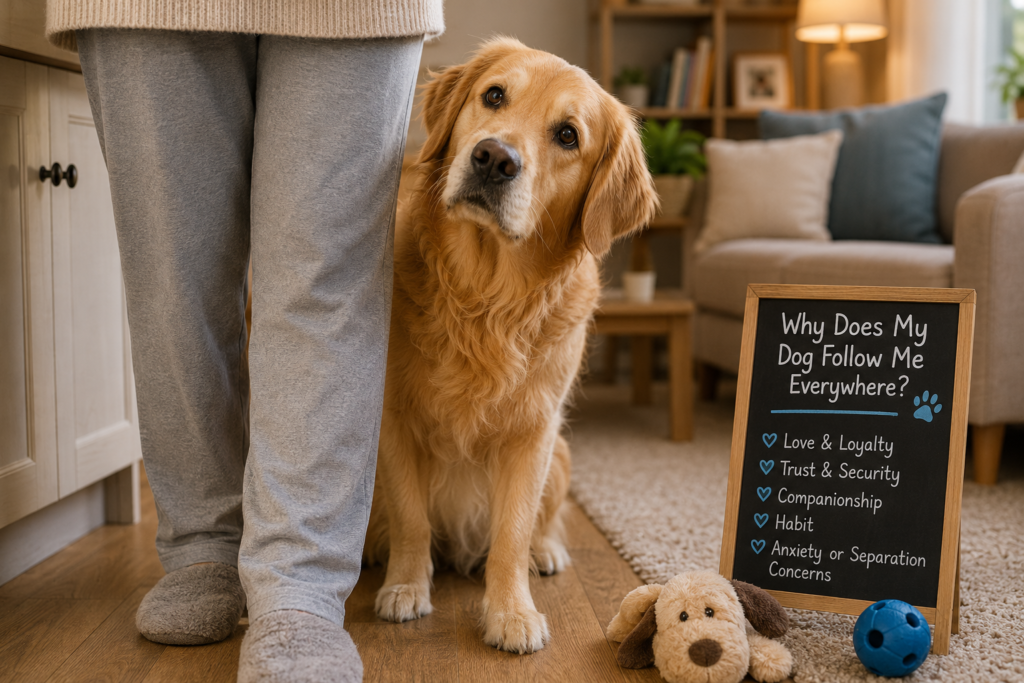
If you’ve ever wondered why does my dog follow me everywhere, you’re definitely not alone.
If this sounds familiar, you may be wondering: Why does my dog follow me everywhere?
In many cases, this behavior is completely normal. Dogs are social animals, and staying close to the people they trust can be part of their natural behavior. Your dog may follow you because they enjoy your company, expect something interesting to happen, have learned that staying nearby brings rewards, or simply because following you has become part of their daily routine.
However, constantly following an owner can sometimes be connected to stress, difficulty being alone, or changes in a dog’s physical or emotional well-being. The important thing is to look at the behavior in context.
In this guide, we’ll look at the most common reasons dogs follow their owners, how to tell normal attachment from a potential problem, and what you can do to help your dog feel comfortable and confident even when you’re not in the same room.
Is It Normal for My Dog to Follow Me Everywhere?
For many dogs, following their favorite person around the house is perfectly normal. Dogs naturally pay attention to the people who provide food, walks, play, affection, and other important parts of their daily routine.
Some dogs simply prefer being close to their owners. They may lie beside your desk while you work, follow you into the kitchen while you prepare dinner, or move from room to room whenever you do.
The behavior itself isn’t necessarily a problem. What matters is how your dog behaves when they cannot follow you.
A dog that follows you around but can also relax alone, sleep in another room, or remain reasonably calm when you leave the house is different from a dog that becomes extremely distressed whenever you disappear from view.
Watch the overall pattern rather than focusing only on the fact that your dog follows you.
7 Common Reasons Your Dog Follows You Everywhere
There isn’t one single reason dogs follow their owners. In many cases, several factors are involved at the same time. Here are some of the most common explanations.
1. Your Dog Feels Safe With You
Dogs often stay close to people they trust. You provide food, shelter, affection, walks, play, and a predictable routine, so being near you may simply feel safe and comfortable.
This is especially common when a dog is still adjusting to a new home. Following you can help them learn the household routine and understand where they fit into their new environment.
If you recently brought home a dog, our Essential Items Every New Dog Owner Needs guide can help you make sure you have the basics covered while they settle in.
2. They Enjoy Your Company
Sometimes the simplest explanation is the right one: your dog likes being around you.
Dogs are social animals, and many enjoy participating in whatever their family is doing — even when that means lying on the kitchen floor while you cook or following you while you carry laundry from one room to another.
If your dog appears relaxed and can also spend time alone without becoming distressed, following you is usually nothing to worry about.
3. Following You Has Been Rewarded
Dogs quickly learn which behaviors lead to good things.
If following you into the kitchen sometimes results in a treat, following you to the door means a walk, or staying beside you leads to petting and attention, your dog may learn that keeping you within sight is worthwhile.
You don’t necessarily have to stop rewarding your dog. Just be aware that your own routine may be helping reinforce the behavior.
4. Your Dog Knows Your Routine
Dogs can become surprisingly good at predicting what happens next.
They may recognize that putting on certain shoes means a walk, opening a particular cupboard means food, or sitting at your desk means they can settle beside you for a while.
Your dog may therefore follow you not because they are anxious, but because they are waiting to see whether the next part of your routine involves something interesting for them.
5. They’re Curious — or Don’t Want to Miss Out
Every trip to another room has potential.
Maybe you’re getting food. Maybe you’re picking up the leash. Maybe someone is at the door. From your dog’s perspective, following you is an easy way to make sure they don’t miss anything interesting.
This type of following is particularly easy to recognize when your dog seems relaxed, playful, or simply curious rather than worried.
6. Breed and Individual Personality Can Play a Role
Some dogs naturally pay closer attention to their people than others. Dogs bred to work closely alongside humans may be particularly interested in their owner’s movements and activities.
But breed alone doesn’t determine behavior. Age, personality, previous experiences, training, environment, and daily routine can all influence how closely an individual dog follows their owner.
So having a so-called “Velcro dog” doesn’t automatically mean anything is wrong.
7. Your Dog May Be Feeling Stressed or Anxious
Following becomes more concerning when your dog seems unable to relax without you.
Watch for other behaviors such as pacing, whining, excessive barking, scratching at doors, destructive behavior, heavy panting when it isn’t hot, or becoming extremely distressed when you prepare to leave.
Following you everywhere by itself does not mean your dog has separation anxiety. It’s the combination of behaviors and what happens when you leave that matters.
If your dog struggles when left alone, our How Long Can Dogs Stay Home Alone? guide provides more information about alone time and factors that can affect how long an individual dog is comfortable by themselves.
Velcro Dog vs. Separation Anxiety
A dog that wants to be near you all the time is sometimes described as a “Velcro dog.” While Velcro dogs and dogs with separation anxiety may both follow their owners closely, the two are not necessarily the same.
A Velcro dog may prefer to stay beside you, follow you from room to room, and choose to sleep near you, but still remain calm when you leave. They may simply have a very social personality or have learned that being close to you is rewarding.
Separation-related distress is different. The problem appears when the dog is separated from their owner or anticipates being left alone.
Possible signs of separation-related distress can include:
- Persistent barking, whining, or howling when left alone
- Destructive behavior, especially around doors or windows
- Pacing or difficulty settling
- Attempts to escape
- Excessive panting or drooling
- Toileting indoors despite being house-trained
- Becoming distressed when you begin your usual leaving routine
It’s important not to diagnose separation anxiety based on following behavior alone. Similar behaviors can have different causes, and some may also be related to medical issues or other behavioral concerns.
If your dog regularly becomes distressed when left alone, speak with your veterinarian or a qualified canine behavior professional. They can help determine what may be causing the behavior and recommend an appropriate plan.
Why Does My Dog Follow Me to the Bathroom?
If there is one place where many dog owners would appreciate a little privacy, it’s the bathroom — but dogs don’t always agree.
Your dog may follow you into the bathroom for exactly the same reasons they follow you elsewhere. They enjoy your company, are curious about where you’re going, or have simply developed a habit of accompanying you from room to room.
For some dogs, a closed bathroom door is actually more interesting than an open one. If they are used to having access to you, suddenly being on the other side of a door may make them curious about what is happening.
Unless your dog becomes distressed when the door is closed or shows other signs of difficulty being separated from you, bathroom following is usually just another version of their everyday shadowing behavior.
Should I Stop My Dog From Following Me?
If your dog follows you around the house but seems happy, relaxed, and comfortable when you’re apart, there usually isn’t a reason to stop the behavior.
For many dogs, staying close to their owner is simply part of their personality and daily routine. If it isn’t causing problems for you or your dog, there’s nothing wrong with having a furry shadow.
However, encouraging some independence can still be useful. Your dog should ideally be able to relax without needing constant interaction or following every movement you make.
It may be worth working on more independent behavior if your dog:
- Cannot settle unless they are beside you
- Immediately gets up every time you move
- Becomes distressed behind a closed door
- Constantly demands attention
- Struggles to relax when another family member cares for them
- Shows signs of distress when left alone
The goal isn’t to make your dog less attached to you. It’s to help them feel secure and comfortable whether they are beside you or relaxing independently.
How to Encourage Healthy Independence
You can help your dog become more comfortable spending time away from you without suddenly shutting them out or removing affection.
Start with small, everyday opportunities for independent relaxation.
Give your dog a comfortable bed or designated resting area and reward them for choosing to settle there. A chew, food puzzle, stuffed toy, or other appropriate enrichment activity can also give them something enjoyable to do without requiring your constant attention.
Practice very short periods of separation around the home. For example, step into another room briefly while your dog is relaxed and return before the situation becomes difficult. The goal is to make being apart feel ordinary rather than dramatic.
Mental enrichment can also help your dog learn to occupy themselves. Sniffing activities, puzzle toys, short training sessions, and appropriate chew toys can provide something meaningful to do besides following you.
For more ideas, see our How to Keep a Dog Entertained While Home Alone guide.
Most importantly, build independence gradually. If your dog becomes genuinely distressed when separated from you, simply forcing longer periods alone may make the situation harder. In that case, speak with your veterinarian or a qualified behavior professional.
When Should You Be Concerned About a Dog Following You?
Following you around the house is usually harmless, especially if your dog has always behaved this way and seems relaxed when you’re apart.
However, a sudden change in behavior deserves more attention. If a dog that was previously independent suddenly starts following you constantly, becoming unusually clingy, or refusing to leave your side, consider whether anything else has changed.
Pay attention to additional signs such as:
- Changes in appetite or drinking
- Unusual tiredness or restlessness
- Difficulty sleeping or settling
- Changes in bathroom habits
- Increased vocalization
- Confusion or disorientation
- Changes in mobility
- Signs of pain or discomfort
- Sudden changes in personality or behavior
Older dogs may also become more dependent on their owners as their hearing, vision, mobility, or cognitive function changes.
These signs don’t necessarily mean something serious is wrong, but a sudden or unexplained behavior change is worth discussing with your veterinarian. This is particularly important if the change is accompanied by physical symptoms or your dog appears uncomfortable.
If your dog has always been your little shadow, eats and behaves normally, can relax independently, and remains comfortable when you leave, following you is much more likely to be part of their normal personality and routine.
Frequently Asked Questions
Why does my dog follow me everywhere and stare at me?
Your dog may be watching you because they are waiting for information about what happens next. They might expect food, a walk, play, attention, or simply be paying close attention to your movements. Your dog may be watching you because they are waiting for information about what happens next. They might expect food, a walk, play, attention, or simply be paying close attention to your movements. If your dog appears relaxed, following and staring are often part of normal communication and routine. If staring is something your dog does frequently, read our Why Does My Dog Stare At Me? What Your Dog Is Really Trying to Say guide for more possible explanations.
Why is my dog suddenly following me everywhere?
A sudden increase in clingy behavior can happen after changes in routine, environment, stress levels, or experiences at home. However, sudden behavioral changes can sometimes accompany pain, illness, sensory changes, or other health concerns. If the behavior is new, persistent, or accompanied by other unusual symptoms, contact your veterinarian.
Why does my dog follow me but not my partner?
Dogs may develop different relationships with different members of the household. Your dog might follow the person who feeds them, walks them, trains them, plays with them most often, or simply the person whose routine they have learned to watch most closely. It doesn’t necessarily mean your dog likes one person more than another.
Does my dog follow me everywhere because they love me?
Affection and a strong bond may certainly be part of the reason. However, dogs also follow people because of routine, learned rewards, curiosity, attention, food, security, or simply because they enjoy being involved in household activities.
Is it bad if my dog follows me everywhere?
Not necessarily. If your dog can relax without you and remains comfortable when left alone, following you around the house is usually not a problem. It becomes more concerning when your dog seems unable to settle without you or becomes distressed whenever you are separated.
How can I get my dog to stop following me everywhere?
You don’t necessarily need to stop the behavior. Instead, encourage healthy independence by rewarding your dog for relaxing in their own bed or space, providing independent enrichment activities, and gradually practicing short periods apart. If your dog becomes distressed when separated from you, seek advice from your veterinarian or a qualified canine behavior professional.
Final Thoughts
So, why does your dog follow you everywhere? In most cases, the answer is simple: they enjoy being close to you, feel safe around you, have learned your daily routine, or don’t want to miss whatever might happen next.
Following you from room to room isn’t automatically a sign of a problem. If your dog can also relax independently and remains comfortable when you leave, having a four-legged shadow may simply be part of their personality.
What matters most is noticing changes. If your dog suddenly becomes much more clingy or shows signs of distress when separated from you, consider what else may have changed and speak with your veterinarian if you have concerns.
A strong bond with your dog is a wonderful thing. Helping them feel safe both with you and on their own can give you the best of both worlds — a dog who loves being by your side but is also comfortable when you’re apart.
Disclaimer
This article is for general informational and educational purposes only and is not a substitute for professional veterinary or behavioral advice, diagnosis, or treatment. If your dog shows sudden behavioral changes, signs of illness, pain, or significant distress when left alone, consult your veterinarian or a qualified canine behavior professional.
Pingback: How Often Should You Bathe Your Dog? - Dog Gift Ideas Hub