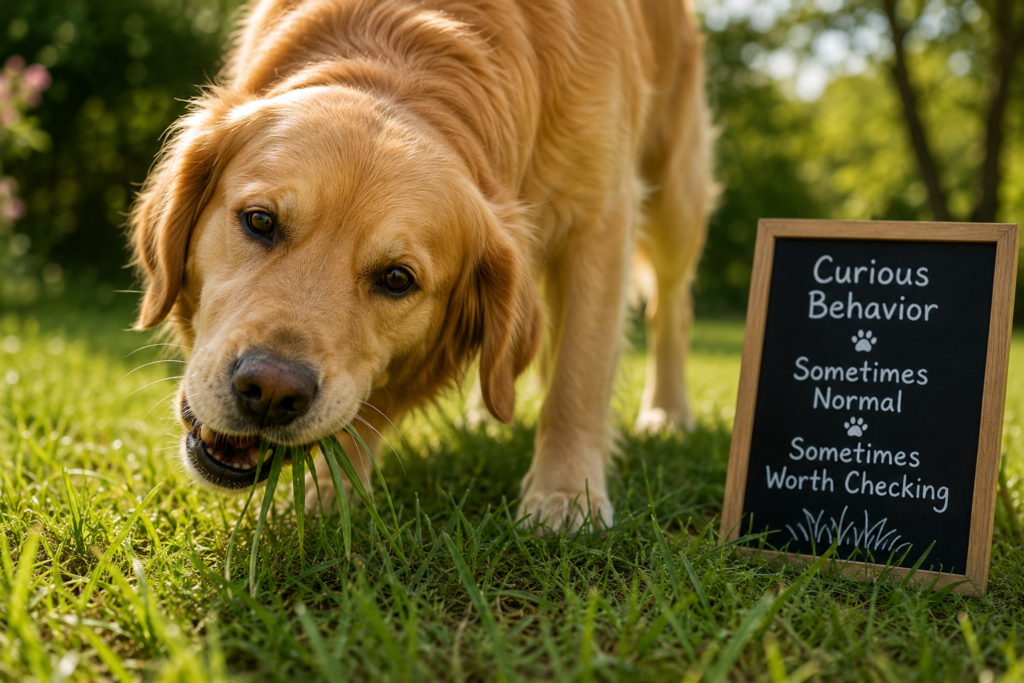
If you’ve ever watched your dog stop in the middle of a walk and start munching on grass, you’ve probably wondered: why does my dog eat grass?
It can look strange, especially when your dog has a perfectly good bowl of food waiting at home. But eating grass is relatively common in dogs, and an occasional nibble doesn’t necessarily mean something is wrong.
Dogs may eat grass because they enjoy the taste or texture, because they’re exploring their environment, or simply because they have discovered something interesting to do. In some cases, grass eating may also occur alongside digestive discomfort or changes in behavior.
The important thing is to look at the whole picture: how often your dog eats grass, how much they eat, and whether you notice vomiting, diarrhea, loss of appetite, lethargy, or other changes.
Here are some of the most common reasons dogs eat grass and when the behavior deserves a little more attention.
1. Your Dog May Simply Like Grass
Sometimes the simplest explanation is the right one: your dog may actually enjoy eating grass.
Fresh grass can have an interesting smell, taste, and texture, especially during spring and summer when new blades are soft and tender.
Dogs explore much of their environment through their noses and mouths. Sniffing, licking, chewing, and occasionally tasting things they encounter outside can all be part of normal exploratory behavior.
If your dog occasionally takes a few bites of untreated grass during a walk and otherwise seems healthy and behaves normally, there may be no obvious reason to stop them.
However, where your dog eats grass matters. Avoid allowing them to eat vegetation that may have been treated with pesticides, herbicides, fertilizers, or other lawn chemicals.
2. Curiosity and Exploration
Puppies are especially famous for investigating almost everything with their mouths, but adult dogs can be curious too.
A patch of fresh grass contains countless interesting smells. Other animals may have walked through the area, rain may have changed the scent, or the grass itself may simply be something your dog wants to investigate.
Some dogs sniff grass and move along. Others decide to taste it.
You may notice this behavior more frequently when visiting a new park, walking a different route, or allowing your dog more time to sniff during walks.
Unless your dog is obsessively consuming grass or showing other concerning symptoms, occasional sampling can simply be part of exploring the outdoors.
3. Your Dog May Be Bored
For some dogs, eating grass may become something to do when there isn’t much else happening.
Dogs need more than physical exercise. They also benefit from opportunities to sniff, explore, play, solve simple problems, and interact with their environment.
A dog that lacks enough stimulation may look for ways to entertain themselves. That could include chewing household objects, digging, barking, pacing — or repeatedly investigating and eating things outside.
If grass eating seems to happen alongside other restless or destructive behaviors, take a look at our Signs Your Dog Is Bored guide for other behaviors that may indicate your dog needs more enrichment.
You can also make daily life more interesting with sniffing walks, short training sessions, food puzzles, interactive toys, hide-and-seek games, and other simple enrichment activities.
For dogs that spend part of the day by themselves, our How to Keep a Dog Entertained While Home Alone guide has additional ideas for creating a more interesting daily routine.
4. Digestive Discomfort May Play a Role
One of the most common beliefs about grass eating is that dogs deliberately eat grass when they feel sick so they can make themselves vomit.
The relationship isn’t quite that simple.
Some dogs do vomit after eating grass, but grass eating does not automatically mean your dog has an upset stomach. A dog may eat grass without vomiting at all.
What matters more is whether the behavior suddenly changes.
If your dog rarely eats grass and suddenly begins consuming large amounts, repeatedly vomits afterward, develops diarrhea, refuses food, seems uncomfortable, or behaves differently than usual, contact your veterinarian.
Grass eating alone tells you very little. Grass eating combined with other symptoms deserves more attention.
5. It May Simply Be a Normal Canine Behavior
Dogs aren’t strict carnivores, and plant material can sometimes be part of what they choose to investigate or consume.
For some dogs, occasional grass eating simply becomes part of their normal outdoor routine.
One dog may carefully select a few blades during every morning walk while another dog may never show any interest in grass at all.
Rather than focusing only on whether your dog eats grass, pay attention to changes in their normal pattern.
A dog that has always occasionally nibbled grass and remains otherwise healthy is very different from a dog that suddenly begins frantically eating large quantities.
Does Eating Grass Mean My Dog Is Missing Nutrients?
Not necessarily.
It can be tempting to assume that grass eating means your dog has a nutritional deficiency, but the behavior alone isn’t enough to determine that something is missing from their diet.
If your dog eats a complete and balanced diet and appears healthy, occasional grass eating doesn’t automatically mean you need to change their food or add supplements.
However, if the behavior becomes excessive or you have concerns about your dog’s diet, weight, digestion, or appetite, discuss those concerns with your veterinarian before making major dietary changes.
Is It Safe for Dogs to Eat Grass?
Small amounts of untreated grass are generally less concerning than the substances that may be on the grass.
Lawns, parks, gardens, and public areas may have been treated with:
- Pesticides
- Herbicides
- Fertilizers
- Weed killers
- Other lawn or garden chemicals
Grass can also be contaminated with feces or other material that you don’t want your dog consuming.
Another concern is that not every plant growing alongside grass is safe for dogs. If you cannot identify a plant, don’t assume it is harmless simply because your dog wants to eat it.
When you’re unsure about an area, preventing your dog from grazing is the safer option.
Why Does My Dog Eat Grass and Then Vomit?
Some dogs vomit after eating grass, particularly if they swallow a large amount quickly.
An isolated episode in a dog that immediately returns to normal may be very different from repeated vomiting.
Pay closer attention if your dog:
- Vomits repeatedly
- Cannot keep food or water down
- Has diarrhea
- Refuses food
- Seems unusually tired
- Appears painful or uncomfortable
- Suddenly begins eating much more grass than usual
Those signs are a reason to contact your veterinarian rather than assuming the grass itself is the only problem.
How Can You Reduce Grass Eating?
If your dog occasionally eats a little safe grass and has no other symptoms, you may not need to eliminate the behavior completely.
If you would prefer to reduce it, first consider when and why it happens.
A bored dog may benefit from additional enrichment. A dog that spends a walk searching for things to eat may benefit from more structured sniffing opportunities, training, and interaction with you.
Try adding activities such as:
- Sniff-focused walks
- Short reward-based training sessions
- Interactive toys
- Food puzzles
- Snuffle mats
- Hide-and-seek games
- Toy rotation
- Appropriate chew toys
If boredom seems to be part of the problem, Signs Your Dog Is Bored can help you identify other clues, while How to Keep a Dog Entertained While Home Alone includes practical enrichment ideas you can use throughout the day.
Don’t punish your dog simply for showing interest in grass. Redirect them toward another activity and reward them for moving away when asked.
When Should You Contact Your Veterinarian?
The occasional mouthful of grass in an otherwise healthy dog is different from a sudden or dramatic change in behavior.
Contact your veterinarian if grass eating is accompanied by symptoms such as repeated vomiting, persistent diarrhea, loss of appetite, lethargy, abdominal discomfort, unusual behavior, or other signs of illness.
You should also seek veterinary advice if your dog suddenly begins eating grass excessively when they rarely did so before.
Your veterinarian can evaluate the whole dog, rather than trying to diagnose a problem based on one behavior alone.
FAQ
Why does my dog eat grass every day?
Some dogs simply develop a habit of nibbling grass. However, frequent or increasing grass consumption is worth discussing with your veterinarian, particularly if it is accompanied by digestive problems, appetite changes, weight changes, or unusual behavior.
Do dogs eat grass because they are sick?
Not necessarily. Dogs may eat grass for several reasons and many appear perfectly healthy before and afterward. Pay more attention to accompanying symptoms than to grass eating alone.
Do dogs eat grass to make themselves vomit?
Some dogs vomit after eating grass, but that doesn’t mean every dog eats it specifically to induce vomiting. Repeated vomiting should be discussed with a veterinarian.
Should I stop my dog from eating grass?
Prevent your dog from eating grass that may have been treated with lawn chemicals or contaminated with potentially harmful substances. If grass eating becomes excessive or is accompanied by other symptoms, contact your veterinarian.
Can boredom make a dog eat grass?
Possibly. Dogs sometimes develop repetitive behaviors when they lack stimulation. If your dog also seems restless, destructive, or constantly searches for things to do, increasing appropriate physical and mental enrichment may help.
Final Thoughts
So, why does my dog eat grass? There isn’t one answer that applies to every dog.
Your dog may enjoy the taste and texture, be exploring an interesting smell, be looking for something to do, or simply have made occasional grass eating part of their normal routine.
Instead of worrying about every blade of grass, pay attention to changes. How often is your dog doing it? Are they eating much more than usual? Are they vomiting repeatedly or showing other signs that they don’t feel well?
Occasional grass eating in an otherwise healthy dog can be very different from sudden, excessive grass eating accompanied by other symptoms.
And if boredom seems to be behind some of your dog’s unusual habits, check out Signs Your Dog Is Bored and How to Keep a Dog Entertained While Home Alone for more ideas to keep their day interesting.
Disclaimer
This article is for general informational and educational purposes only and is not a substitute for professional veterinary advice, diagnosis, or treatment. If your dog suddenly begins eating excessive amounts of grass or develops repeated vomiting, diarrhea, loss of appetite, lethargy, pain, or other concerning symptoms, contact your veterinarian.